ASO.dev vs AppTweak in 2026: Which Should You Choose?
We are the ASO.dev team. We verified this comparison on September 8, 2026: we have a stake in your choice, so we explicitly show where AppTweak is stronger than us. Calculations are in US dollars and exclude taxes and external services.
You need to find ideas, update store pages, and answer reviews without counting every new keyword or competitor. ASO.dev is usually the practical starting point: Indie is the budget option, while Pro suits recurring professional work.
ASO specialist managing a portfolio
You want to maintain broad keyword coverage, compare apps quickly, and carry changes through to App Store Connect. ASO.dev prices the workspace around a seat and connects research with localization, creatives, and publishing.
Product team or agency
You need Android data, market estimates, consolidated reports, and enterprise support. AppTweak is often the better fit here; using both can make sense when those data are needed for only part of the portfolio.
What drives the decision
Choice and reason
Android and data across 100+ countries
AppTweak: Google Play intelligence and global coverage
Market estimates and consolidated reports
AppTweak: market estimates and reports combining several sources
A broad App Store portfolio
ASO.dev: core app, keyword-list, and manually added competitor scope does not raise the seat price
Localization and publishing
ASO.dev: turn one hypothesis into copy and visuals for 50 localizations
Review operations
depends: AppTweak server-side rules or ASO.dev controlled replies and local credentials
Apple advertising research
depends: frequent ASO.dev monitoring or AppTweak campaign management; both research ads
AppTweak is primarily a global research and enterprise intelligence layer. Its ASO Intelligence covers the App Store and Google Play, while its public plans claim more than 30 million keywords across over 100 countries.
At ASO.dev, we are building a specialist’s workspace that does more than find a hypothesis: it carries that hypothesis through to the store. The core ASO area contains 19 specialized tools, plus Tasks, Subscriptions, and Notifications. The main subscription unit is a person rather than a row of data.
We do not want you deciding whether the 501st keyword or the 11th app deserves a plan slot before research begins. Apps, keyword lists, and manually added competitors do not increase the price of one seat, so a specialist rejects hypotheses based on evidence rather than the cost of another slot. Connected developer accounts and workspaces are not sold as separate slots within a seat either.
That does not mean “everything is unlimited.” ASO.dev plans differ in history depth and features; Tasks, Subscriptions, advertising monitoring, and the API have their own operational quotas. We removed limits where they obstruct research and kept them where cost depends on computation, frequency, or plan composition.
Indie. Includes the core research workflow and 30 days of detailed history.
Pro. Adds exports, extended history and trends, Custom Product Pages, App Clash, and Changelog.
Marketing. Adds Apple Ads research, but not advertising campaign management.
AppTweak also offers unlimited live keyword searches. The difference appears when you continuously track a dataset and build its history: AppTweak applies plan quotas here, while our core research scope can grow within one seat.
The workspace does not end with rankings. The App Store editor and Google Play editor work with store consoles; TestFlight builds and Apple Developer operations form a separate execution layer and are not folded into an artificial “19 tools” count.
Android and local markets. AppTweak researches Google Play keywords and covers more than 100 countries. ASO.dev does not currently have comparable Android keyword intelligence.
Market sizing. Market Intelligence provides estimates of downloads, revenue, and market share. ASO.dev measures connected-app data but does not replace these market estimates.
Reporting for larger teams. Reporting Studio builds consolidated reports from AppTweak, store-console, Apple Ads, and mobile measurement partner (MMP) data. For an agency or growth team, that may matter more than editing the store page directly.
History depth and enterprise service. Public plans claim up to 6, 12, and 24 months of history, with metric-specific caveats. Enterprise adds ASO Agent for metadata suggestions, consulting, and shared workspaces; the separate AI Visibility product measures app recommendations in ChatGPT and Gemini. We do not have a direct equivalent to this enterprise package.
Ready-made review analytics. App Reviews Manager includes topics and sentiment, templates, team metrics, and Slack, Zendesk, and Salesforce integrations. ASO.dev provides data, exports, and controlled replies, but fewer ready-made dashboards and server-side rules.
Broad research without buying more object slots. One specialist can expand the portfolio, keyword lists, and manually added competitors within a seat. Competitor discovery and organic keyword discovery start with one click, although automated reports have separate limits.
Large results in one working table. The desktop client for macOS, Windows, and Linux loads a result set into one working view, where it can be filtered, sorted, and exported without manually assembling dozens of pages. Externally sourced store data, such as reviews, may still load in batches.
From an idea to App Store Connect. The bulk editor and screenshot upload expand a change across 50 localizations. A person reviews and submits the result; Xcode, Fastlane, or CI uploads the binary.
Competitor advertising observability.Ads by keyword and ads by app connect queries, advertisers, creatives, and Custom Product Pages. Selected queries are checked approximately every seven minutes with history retained; AppTweak also covers both ad slots, while we do not yet manage campaigns.
Data for AI and controlled actions. Pro and higher plans can export large datasets, while the local AI Companion connects your chosen AI assistant to the editor and reviews. It does not replace bulk exports, and submitting changes requires user confirmation.
For one specialist with 10 active apps, we consider Pro the realistic ASO.dev baseline: $89 month to month or $828 per year. Indie at $39 month to month or $348 per year suits your own apps when 30 days of history is enough and exports, Custom Product Pages, and other Pro features are unnecessary.
Total cost of ownership (TCO) includes subscriptions, extra modules, and external costs. The table compares subscriptions for one tracked storefront per app and up to 500 review replies per month; multiple storefronts are covered in the detailed calculation.
Scenario, one specialist
ASO.dev
AppTweak
1 app, core ASO
Indie $348/year; Pro $828/year
Essential $949/year; replies add $990/year
10 apps × 50 keywords + replies
Pro $828/year
Grow + Reviews Small $3,980/year
10 apps × 200 keywords + replies
Pro $828/year
Grow or Grow Plus + Reviews Small $3,980–6,980/year
50 apps
Pro $828/year per seat
ASO Intelligence: Enterprise, price on request
In the full scenario, 2,000 app-keyword pairs do not necessarily consume 2,000 AppTweak quota units: some keywords may repeat. With 2,000 distinct tracked queries, Grow Plus is required; Grow may fit when deduplication leaves no more than 1,500. Confirm cross-app deduplication with AppTweak: two official guides describe it at different levels of specificity.
ASO.dev Pro’s annual price equals $69 per month per seat, or about $6.90 per app for a portfolio of ten. This illustrates budget allocation, not a per-app price. Two working specialists require two seats: $1,656 per year.
Marketing costs $199 month to month or $1,788 per year and adds Apple Ads research. External AI provider tokens, taxes, ad spend, and consulting are not included. AppTweak charges for a package with account quotas; these plans do not publish a separate unit price for each app or keyword.
Plans and the full scenario calculation
The shared scenario is one user, 10 apps, up to five storefronts per app, five competitors per app, regular updates, and review replies. Light means 50 keywords per app, or 500 app-keyword pairs; full means 200 per app, or 2,000 pairs in one storefront.
AppTweak plan
Annual price
Keywords
Apps
Competitors per app
Seats
Plan history
Essential
$949
500
5
5
1
6 months
Grow
$2,990
1,500
10
10
1
12 months
Grow Plus
$5,990
3,000
15
15
1
Up to 24 months
Enterprise
on request
contracted
contracted
contracted
contracted
contracted
Month-to-month ASO Intelligence prices are $99, $299, and $599 respectively. Reporting Studio includes 10, 15, and 20 reports; shared workspaces require Enterprise. AI Visibility, consulting, and the complete enterprise package need a separate quote. Check history for the metric you need, not just the plan card.
App Reviews Manager is selected separately: Small is $990 per year with 500 replies per month; Medium is $2,990 with 1,500; Large is $9,990 with 5,000. Month-to-month prices are $99, $299, and $999. Each includes five seats and unlimited apps; server-side reply rules require Enterprise.
AppTweak’s Keyword Tool FAQ says a repeated keyword in the same store, country, and language counts once across lists and user accounts. Create and manage lists of keywords explicitly guarantees this within one app. Therefore 500/2,000 pairs describe our workload, while the required plan depends on actual account usage.
If all ten apps have disjoint lists tracked in full across five countries, light becomes 2,500 queries: Grow Plus + Reviews Small costs $6,980 per year. Full becomes 10,000 queries and requires Enterprise. If all apps share the same 200 keywords, the broader FAQ interpretation gives 1,000 units across five countries, which may fit Grow. Do not treat that lower bound as guaranteed without checking Company Usage.
For 501–1,500 replies per month, choose Medium instead of Small: Grow + Reviews Medium costs $5,980 per year; Grow Plus + Reviews Medium costs $8,980. Market intelligence has its own scope too: Market Intelligence Free provides basic previous-month estimates, Explore costs $6,590 per year, and extended Enterprise terms are private.
Prices and rules were rechecked on September 8, 2026. They exclude team labor and do not imply identical feature sets: this calculation compares research and replies, while ASO.dev’s direct publishing workflow is described separately.
This is a modeled scenario, not a customer story or a promise of results within a fixed period. A portfolio follows one path: data → hypothesis → localization and creatives → publishing → measurement.
Find an opportunity. AppTweak helps identify a direction through local data, localization insights, creative analysis, competitor tests, and app-page previews. In ASO.dev, automated competitor and organic keyword discovery creates a working set, while rankings refresh every four hours.
Validate the hypothesis. The specialist compares competitors, keyword intersections, and user feedback. ASO.dev provides App Overview, App Clash, and review exports for this work; the team still makes the final decision.
Prepare copy and visuals. Once an idea is selected, the editor distributes metadata across 50 localizations. The Figma plugin updates text in designs, while folder import assigns media to localizations and devices; translations and visuals still need review.
Test variants. The same workflow supports Custom Product Pages and Product Page Optimization. Apple allows up to 70 Custom Product Pages and up to three test treatments; a test requires an approved version, and icon variants must be present in the binary.
Publish and measure. The specialist selects an already uploaded build and submits metadata for review. After release, they compare rankings in ASO reports, and conversion and revenue in Measurements. AppTweak remains stronger for market estimates and consolidated reporting.
AppTweak Essential, Grow, and Grow Plus include 500, 1,500, and 3,000 tracked keywords respectively; 5, 10, and 15 followed apps; and the same number of competitors per app. “Unlimited Live Keyword Searches” means unlimited live searches, not unlimited tracking.
In ASO.dev, organic keyword discovery and competitor discovery start with one click. The automated competitor report returns up to 50 results for your own app on Indie and up to 250 for any app on Pro or Marketing. Organic keyword discovery uses competitor data from the last seven days and returns up to 5,000 keywords on Indie or 20,000 on Pro/Marketing. These are report quotas, not limits on manual research.
Selected keywords can be added to a list in bulk and tracked from there. The desktop client opens a large result in one working table, so you do not have to assemble pages of 50–100 rows manually. This is not a claim that pagination never exists: store reviews and TestFlight can still load additional pages.
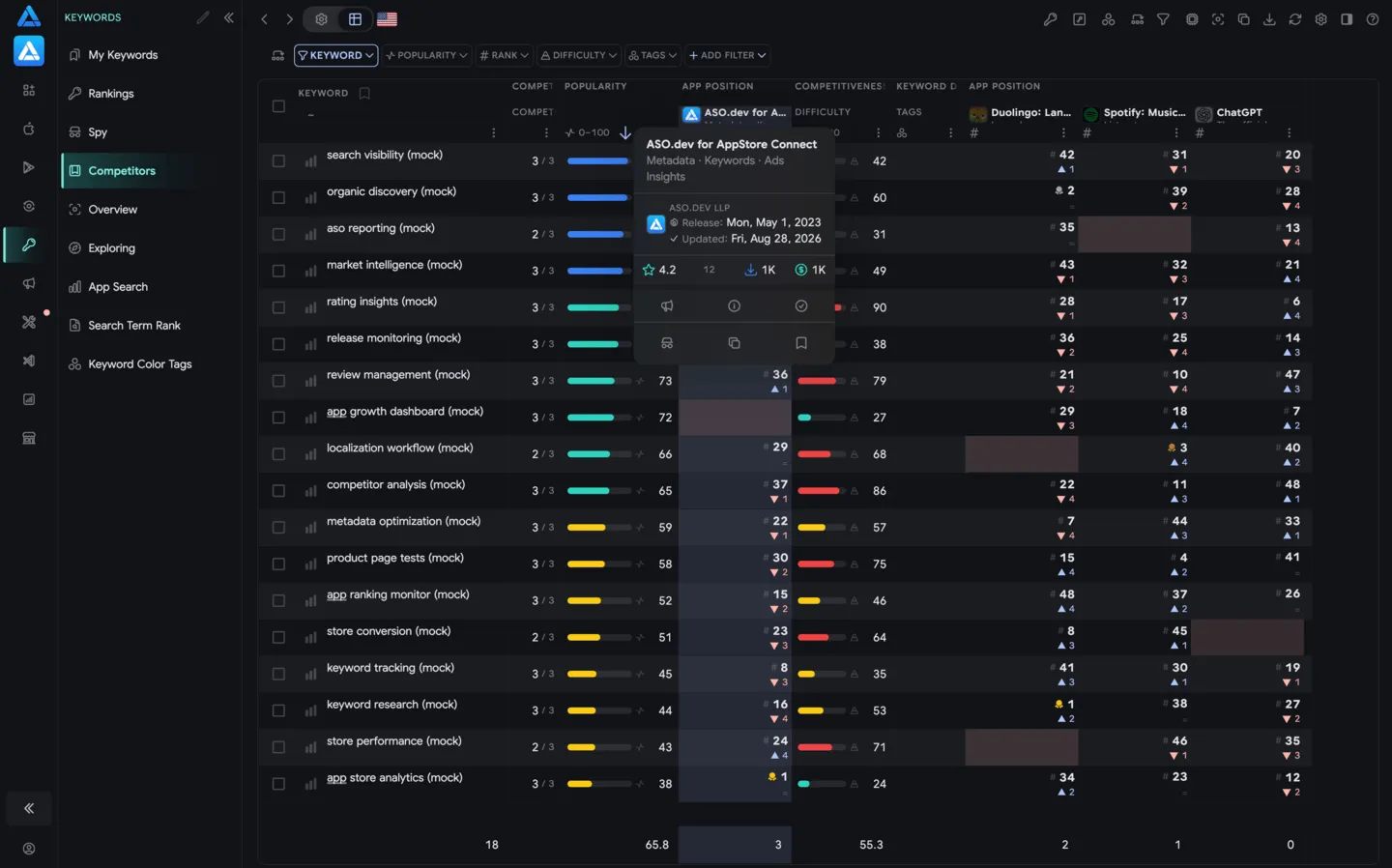
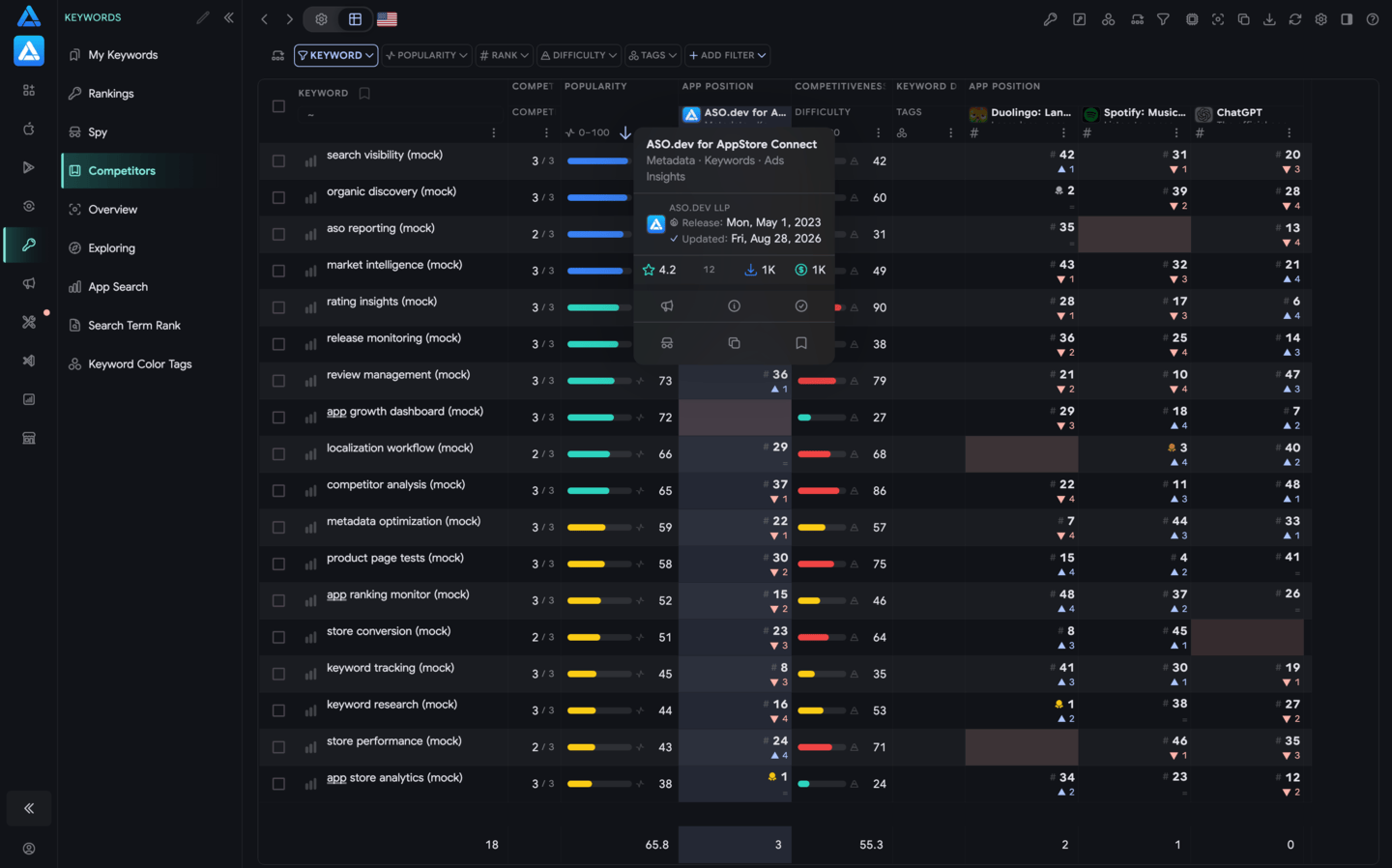
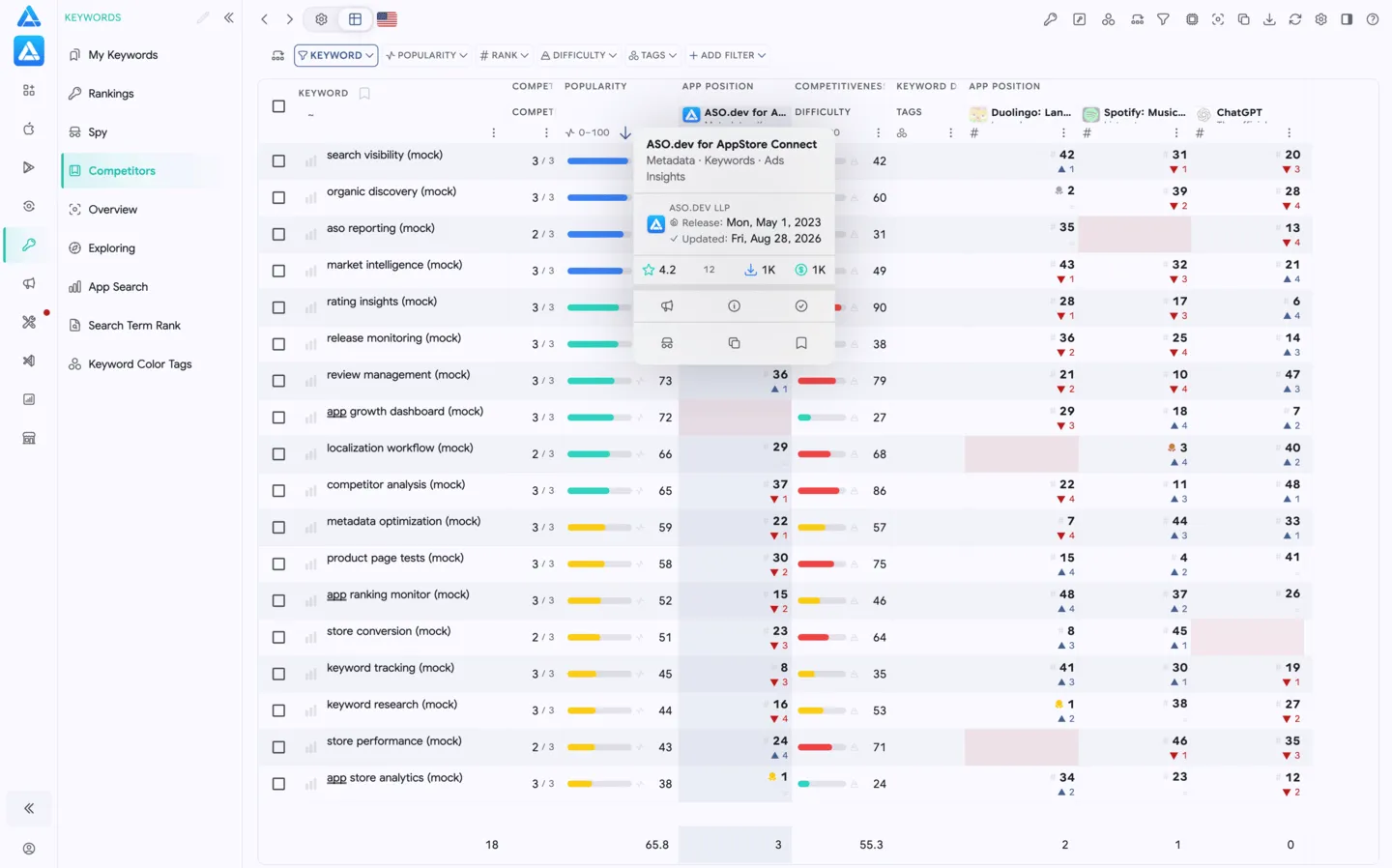
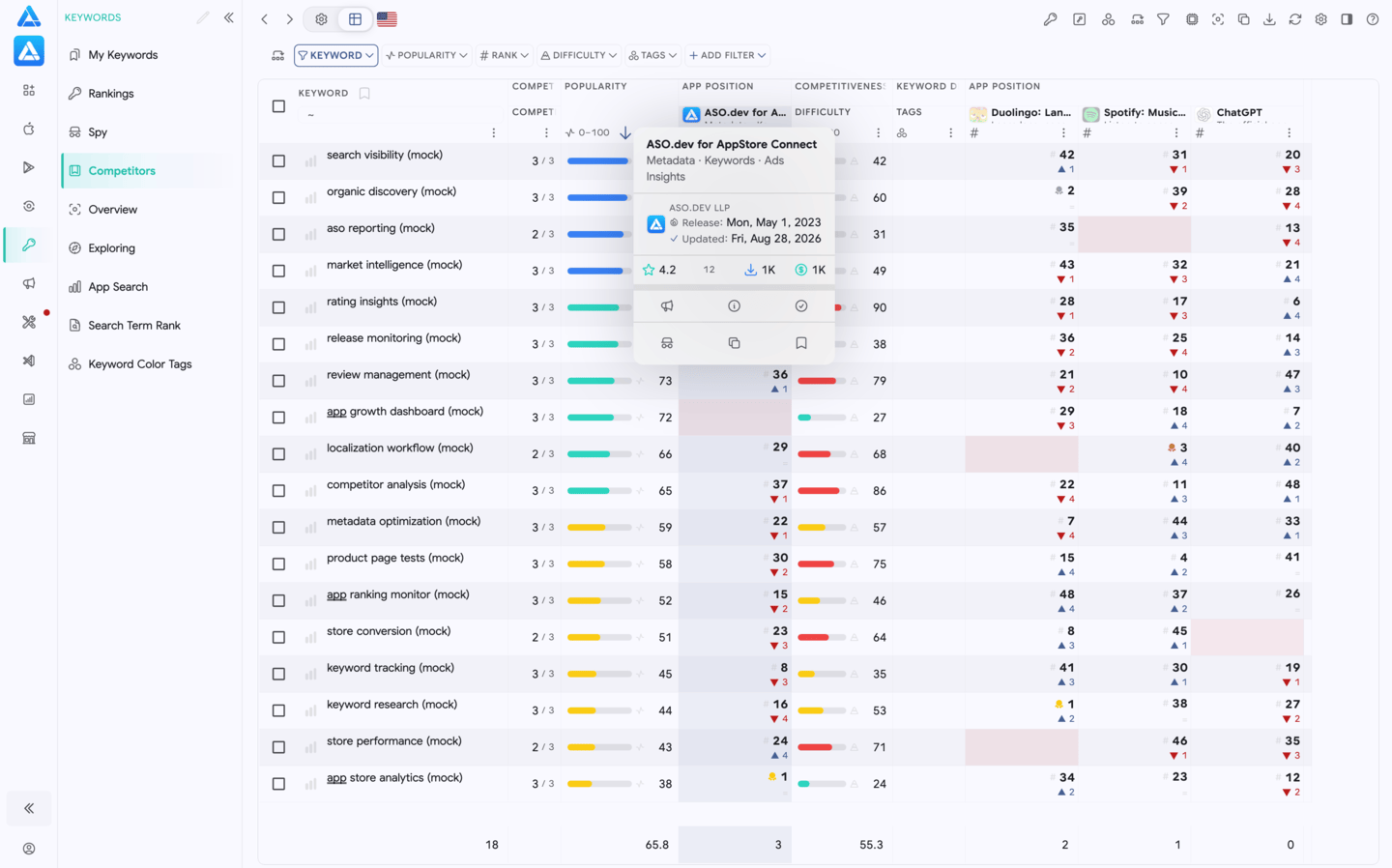
What this screen gives you: apps and competitors compared for selected queries in one working dataset.
100%
App and competitor rankings for selected keywords in ASO.dev
100%
App and competitor rankings for selected keywords in ASO.dev
AppTweak remains a strong research layer: local data, creative analysis, competitor tests, and app-page previews help choose a direction. ASO.dev also provides tools for keywords, competitors, and diagnostics, but its main distinction appears after the hypothesis is selected.
The metadata editor expands an idea across 50 supported App Store localizations. Copy can be translated, edited, and validated in bulk within one workflow.
The free Figma plugin transfers copy through JSON or ZIP and updates localized frames while preserving Auto Layout, Variables, and right-to-left direction. Folder import assigns screenshots and videos by localization and device, validates files, saves progress, and lets you retry only the failed part.
The same workflow covers the default product page, Custom Product Pages, and product-page tests. You can copy localizations, screenshots, and promotional text between Custom Product Pages; the feature is available on Pro and Marketing. Product-page tests support up to three treatments with localized screenshots or video and submission to App Review.
This is not a magic autopilot: the team reviews translations and media, and changes must be explicitly saved and submitted. A test runs against an approved version, and icon variants must be included in the binary.
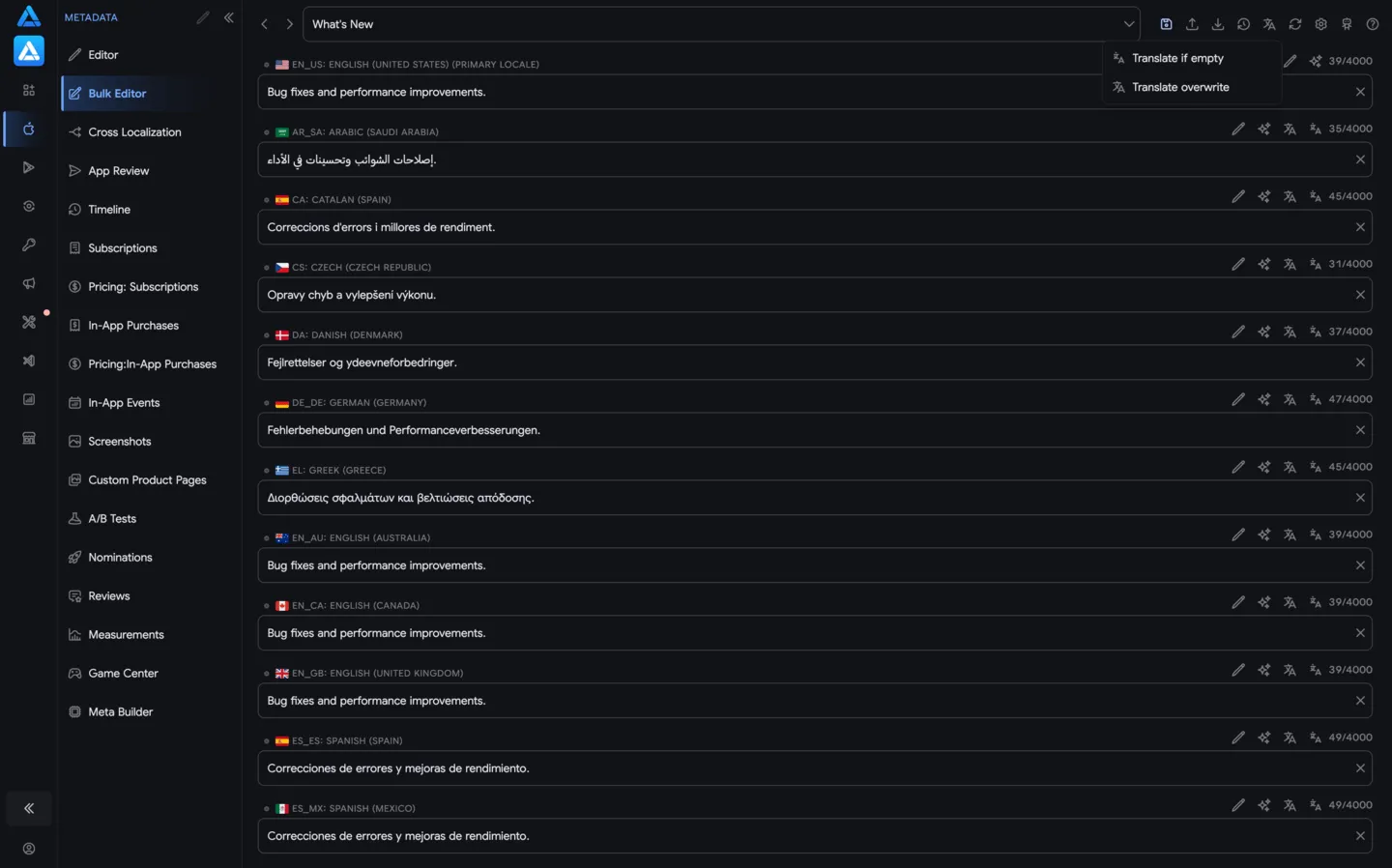
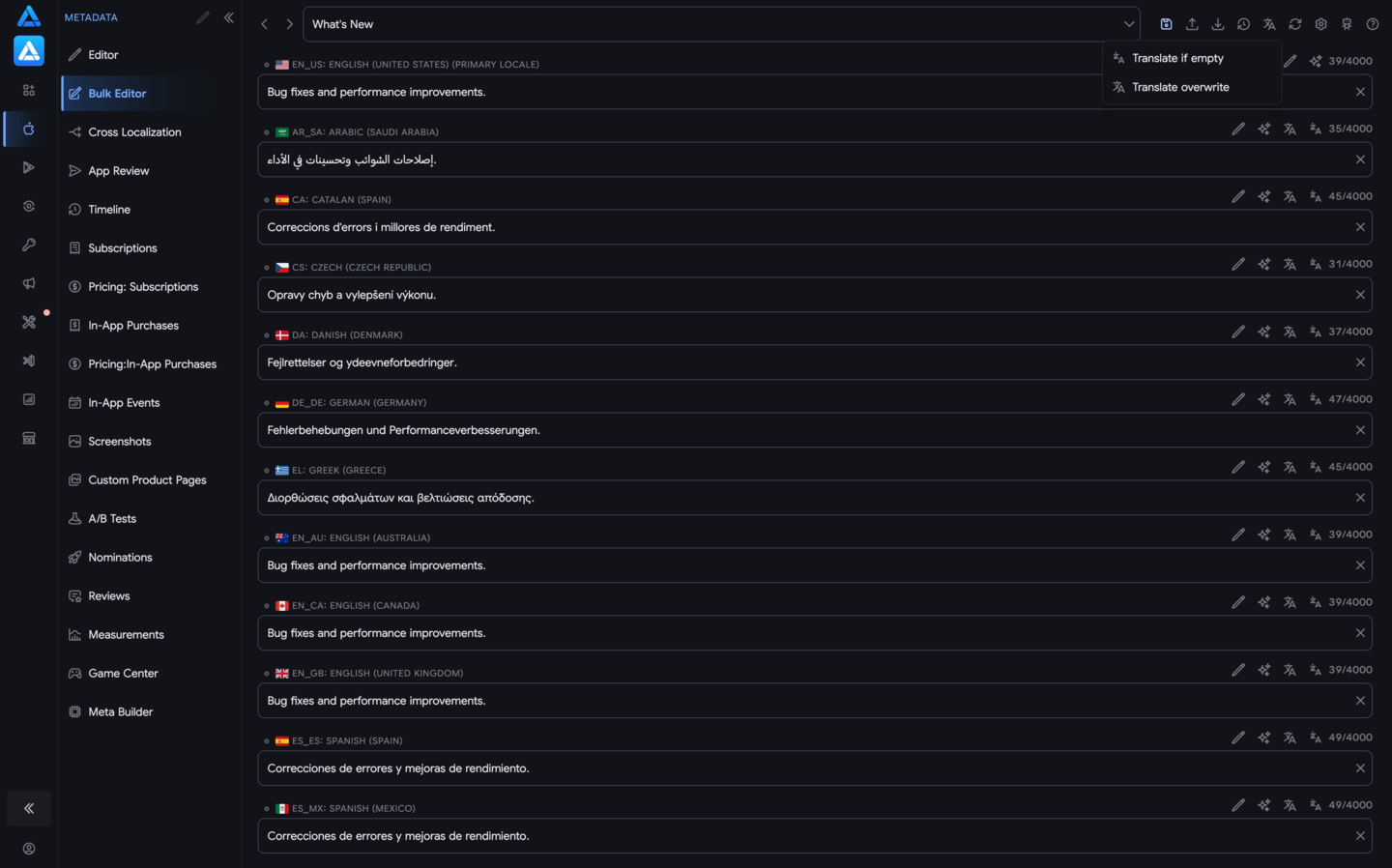
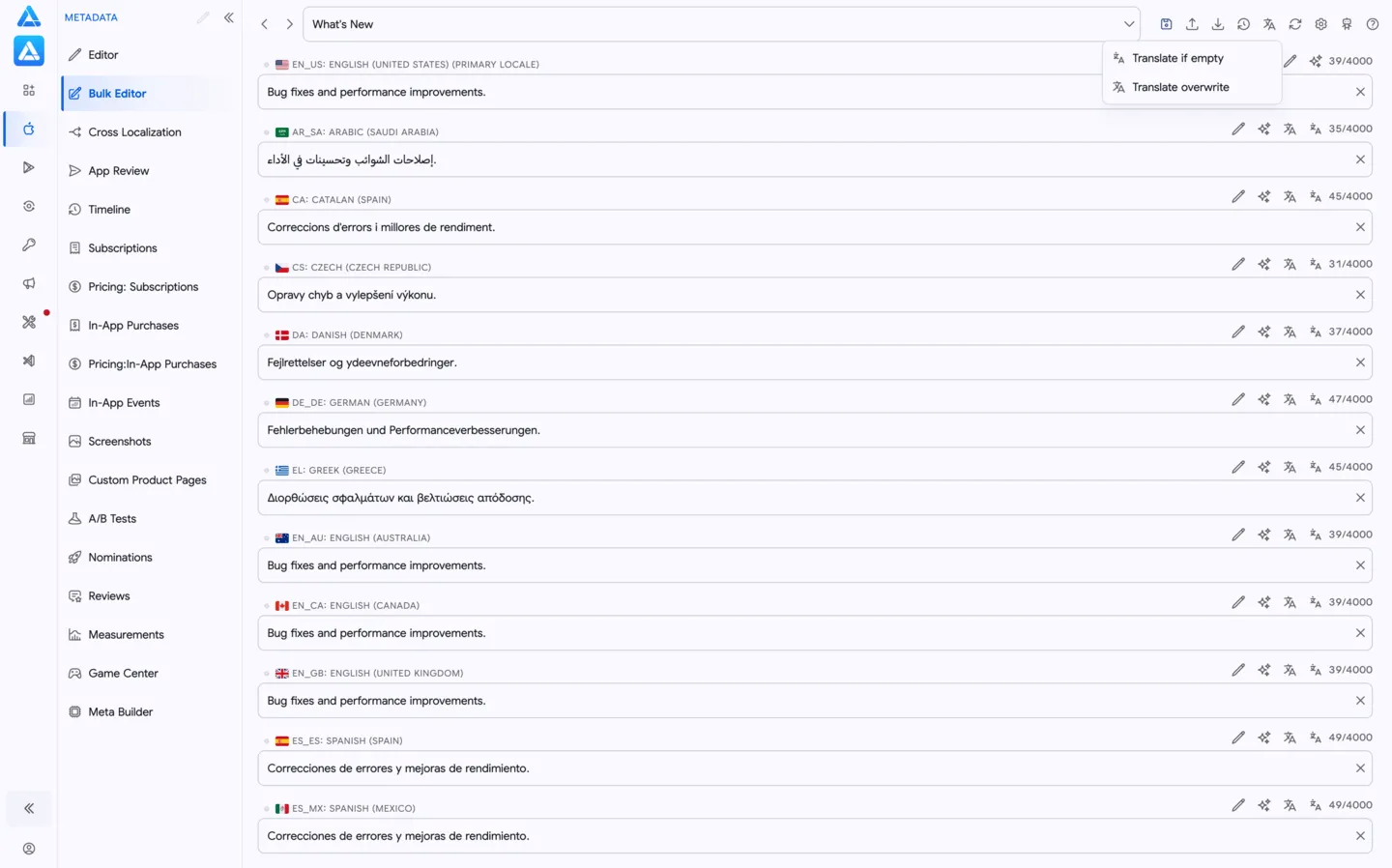
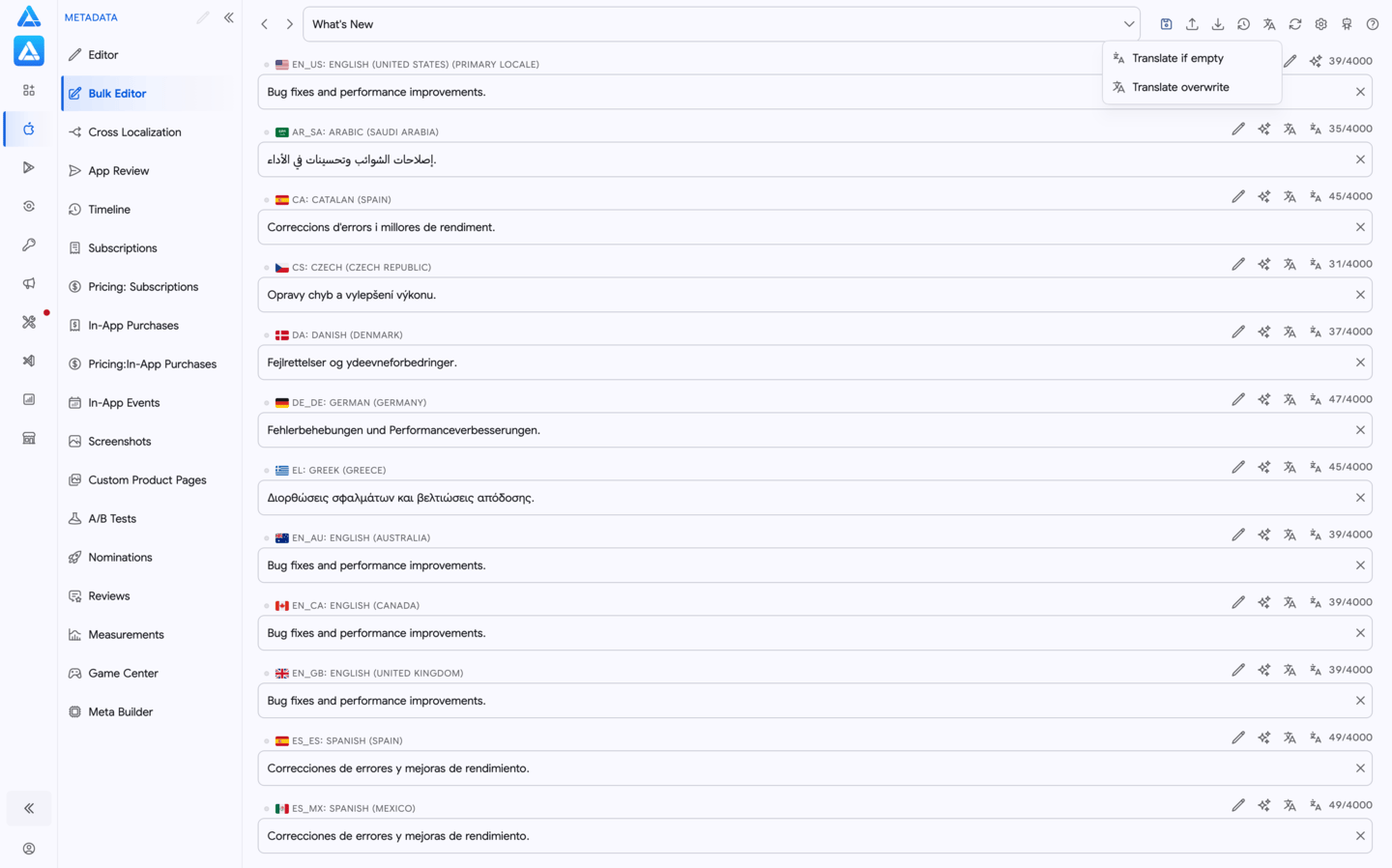
What changes after choosing a hypothesis: copy for supported localizations is edited together instead of in separate country cards.
100%
Bulk editing App Store metadata localizations in ASO.dev
100%
Bulk editing App Store metadata localizations in ASO.dev
In ASO.dev, a specialist selects an already uploaded build, submits metadata for review, and releases the approved version. Xcode, Fastlane, or CI still uploads the binary; the pricing editor manages in-app purchases and subscriptions.
We did not find confirmation in AppTweak’s official materials of a comparable workflow for writing and publishing metadata across 50 localizations. This remains unknown, not proof that the capability is absent.
After release, compare rankings in ASO reports, and conversion and revenue in Measurements for the connected App Store Connect account. If you need whole-market estimates, mobile measurement partner data, and consolidated reporting across sources, AppTweak is stronger.
AppTweak is stronger as a ready-made support system. App Reviews Manager includes sentiment and topic analysis, templates, bulk replies, team metrics, and Slack, Zendesk, and Salesforce integrations. Reply Automation on Enterprise can reply by rule without manual confirmation.
In ASO.dev, a Subscription monitors new reviews by app, country, and event. The result remains in Notifications, while Pro and Marketing can deliver it by push or webhook. The webhook contains event counts, a preview, and a link to the full CSV.
The Reviews interface translates and filters entries, shows reply status, and indicates when a review changed after a reply. It creates a single AI reply from your prompt and can start batch processing for a selected group by period, rating, and reply state.
This is user-triggered batch automation, not an always-on server bot. You connect your own model, so ASO.dev does not sell separate credits for every reply; tokens and limits belong to the selected AI provider.
Replies are actually sent to the App Store and Google Play from ASO.dev. MCP, a protocol for connecting AI to tools, can also prepare, submit, and edit replies after explicit confirmation. Reporting an App Store review additionally requires an Apple app-specific password.
Review workflow
AppTweak
ASO.dev
Monitoring
Several updates a day, CRM, and integrations
Subscriptions, Notifications, push, and webhook
Direct replies
App Store and Google Play
App Store and Google Play
AI draft
GPT, prompts, and templates
Your provider, model, and prompt
Bulk replies
Available
Available, user-triggered
Autonomous rules
Enterprise
No server-side autopilot
Analysis and export
Topics, sentiment, metrics, CSV
Filters, translation, CSV by country
Review MCP
Write operations not confirmed
Read, prepare, submit, and edit
Store credentials
Stored encrypted by AppTweak
Device secure storage
For the full archive, the review export Task downloads CSV for selected countries—up to 175—for sentiment, topic, and feature-request analysis. MCP works with the current review and loaded list, can filter and load additional pages, and therefore does not replace a full export.
App Store Connect and Google Play credentials stay in the device’s secure storage. Management requests go from the user’s device directly to Apple or Google, or through a user-selected proxy. We do not promise zero risk: the user controls permissions and can revoke the key.
Review access and actions in detail
AppTweak. Connects store service users, fetches new data several times a day, and stores credentials in encrypted form. Its connection documentation describes most of the integration scope for the latest 90 days; the exact internal credential-storage architecture is not disclosed.
App Store in ASO.dev. An individual key needs the Customer Support role; a team key needs Admin. The interface can submit and edit a reply and show whether the review changed after the reply.
Google Play in ASO.dev. The service account needs View app information (read-only) and Reply to reviews. The interface supports submitting and editing replies.
Local MCP. It reads the current review and loaded list, filters entries, and loads additional pages. Apple supports draft, submit, edit, and report actions; Google Play supports draft, submit, and edit.
Write confirmation. Every write tool requires confirmApply=true after user approval. Bulk mode prepares drafts; this is controlled agent work, not a background bot.
Our research advantage is frequent monitoring of selected queries and tracing a creative back to related keywords. AppTweak also researches competitors through Enterprise Ad Intelligence and covers both ad slots in App Store Search Results. Its separate Campaign Manager creates and runs campaigns; ASO.dev does not yet offer campaign management.
From query to ad. See which apps advertise, which creatives they use, and which Custom Product Pages appear.
From app to queries. See the keywords for which an app appears and the media associated with those appearances.
We show both ad positions: Ads 1 and Ads 2. Ads 2 is the second ad slot and the third overall position in Search Results. For a selected creative or Custom Product Page, you can retrieve up to 5,000 related search queries and understand the context in which that media appeared. This is a result cap for the selected media identity, not conversion attribution and not 5,000 keywords for every file.
One share-of-voice (SOV) subscription monitors up to 200 queries with a selected country approximately every seven minutes. For example, one query in the US and Germany uses two of the 200 slots. According to ASO.dev’s July 2026 data, a separate automated pool covers roughly 45,000 queries with average Apple Ads Popularity (SAP) of 60+ on a different schedule.
AppTweak documents 50 searches per day for each keyword in Keyword Monitoring. General Ad Intelligence collection usually runs once per day. Our frequency advantage applies to user SOV subscriptions; it does not establish greater coverage of all keywords or more accurate market estimates.
SAP is checked daily through Apple’s official API; four-hour ranking updates are a separate process. Historical data is available from September 2024, with depth and access depending on the plan. The SAP tooltip shows the latest database-update date and clicking opens history; that date is not the exact moment Apple changed the value.
Viewing a keyword raises its refresh priority: a stale value may update within seconds or by the next day, depending on the queue. SOV history and check times help verify an observation, but do not turn it into a continuous data feed.
Daily observation allowed us to be among the first to publicly record the Apple Ads Popularity drop: the number of US queries with a score above 5 fell by 77.4%. After the anomaly, we display a smoothed average that excludes problematic values of 5 while retaining Apple’s actual values in history.
AppTweak also retains history and obtains Search Popularity from Apple. Pricing describes daily collection, while Data Delivery Schedule specifies weekly updates for iOS keywords with a value of 5. Official pages do not clarify how that exception applies after the model change; a last-check timestamp in the interface remains unconfirmed.
Since August 11, 2026, AppTweak displays its own Volume Estimate by default. Raw Search Popularity can be enabled in the columns; the API field volume now means the estimate, while search_popularity means Apple’s raw score. Previous history is not rewritten, and charts mark the methodology change.
Its anomaly response is documented too: AppTweak temporarily retained last-known values in October 2025, returned to Apple’s values on February 2, 2026, and introduced the estimate in August. When comparing services, first check whether you selected the raw score or a smoothed estimate. Both have history; ASO.dev’s advantage here is the database-update date visible beside the metric, not a claim that we discovered the anomaly first.
Keep AppTweak for priority apps, markets, and the capability you genuinely need: Android, market, predictive, or enterprise intelligence.
Move selected hypotheses by export, when available, or manually. Keywords can be pasted in bulk into a keyword list, and competitors can be added to the project.
Manage the broader portfolio in ASO.dev: tracking, Tasks, Subscriptions, metadata, creatives, reviews, and releases.
In this setup, ASO.dev is the working hub, not a universal connector. We do not promise automatic synchronization of AppTweak proprietary metrics, history, or estimates. ASO.dev alone is enough for many teams; the combined stack is justified only when the independent signal is valuable.
Large datasets are useful for cleaning, deduplication, clustering, relevance scoring, competitor-gap analysis, and preparing localized metadata. A marketing checkbox that says “MCP available” is not the same as a practical path to the data.
AppTweak’s MCP helps an agent explore the API and design an integration: searching documentation, schemas, and endpoints is free and requires no account. Only execute-request makes a real call using an API key and spends credits; its response shows the operation’s cost. This is a documented strength for planning automation before buying a subscription.
AppTweak hosts the server; data-call authentication uses x-apptweak-key. It exposes the core ASO dataset, connected App Store Connect/Google Play Console data, and account utilities. MCP access is included in public API plans; a beta label, exact transport variant, and separate quota are not published.
Top Installs (Keyword Suggestions by App) returns JSON in pages of 500 rows using an offset and accepts up to five apps within one country, language, and device configuration. If 20,000 suggestions genuinely exist for an app, retrieving them requires 40 pages and at least 20,040 credits. Combining apps, calculating intersections, and finding gaps must be implemented in your own code.
The local ASO.dev MCP gives AI the context of the current editor, metadata, and reviews, and performs confirmed actions. MCP is not a bulk keyword endpoint and does not consume Developer API credits; tokens for the selected external model are billed separately. Alpha status applies only to the separate Developer API for server-to-server automation.
For large datasets, we use this sequence:
Get an Excel or CSV export on Pro or higher without per-row Developer API credit charges.
Analyze the file in Codex, ChatGPT, Claude, or another chosen tool.
Return to the local MCP for context and actions in the current editor.
App Clash and other app comparisons can return more than 20,000 rows in one working dataset when the report contains that volume. The automated organic-keyword Task on Pro/Marketing has a separate limit of 20,000 results; this is not a promise of unlimited size for every report.
Question
AppTweak
ASO.dev
Official MCP
Remote gateway to the API
Local AI Companion
Status and hosting
Remote server; access included in API plans
Available locally in the desktop app
Primary MCP job
Documentation, API and connected-console data
Editor context and confirmed actions
MCP credits
Documentation is free; executing data calls costs credits
Developer API is not affected
20,000+ app keywords
API: 500 rows per page, if enough data exists
Pro and higher: Excel/CSV, if the report contains that volume
Multi-app intersections
Up to five apps per request; client-side calculation
App Clash and exports on Pro and higher
API price
Lite $1,990/year; then Pro and Power
Developer API: closed alpha
Practical route
MCP/API and custom code
Export → external AI → local MCP
Exact API, export, and security limits
AppTweak API. Lite costs $1,990 per year with 200,000 monthly credits; Pro is $2,990 with 500,000; Power is $9,990 with 3 million. Month-to-month prices are $199, $299, and $999. Each includes one API key, MCP, and up to 10 years of history subject to data availability; the rate limit is 60 requests per 10 seconds. External model tokens are billed independently.
20,000 AppTweak rows. Keyword Suggestions by App returns no more than 500 rows per request. The Top Installs corpus contains keywords for which the app ranked in the top 100 at least once during the last 90 days; there is no arbitrary date-range parameter. Retrieving 20,000 rows is possible only if that volume exists for the app. A single UI-export cap is not confirmed.
Multiple apps in AppTweak. The API accepts up to five apps and returns separate arrays. We did not find a documented ready-made export of a 20,000+ row union, intersection, or gap. Automated Exports delivers ZIP/CSV for followed apps and keywords as a separate subscription, while S3 or Google Cloud Storage delivery belongs to Enterprise.
ASO.dev Developer API. This is a separate closed alpha for scheduled and server-to-server workflows, with access starting at Pro. Confirmed surfaces include app data, rankings and history, popularity, and category rankings; machine requests use credits and provide a cost estimate. The alpha tests methods, load, data quality, and pricing mechanics, so contracts, formulas, and limits may change.
AI Companion actions. AI can read loaded context, prepare changes, and work with reviews. Every write requires explicit user confirmation; the local MCP does not become a server-side autopilot.
Additional AppTweak metrics. The minimum 20,040 credits covers retrieving 20,000 keywords for one app, but not additional rankings, popularity, or history. Those are charged separately under API Data Pricing.
Yes, when the core workflow centers on the App Store. Pro does not limit the number of apps researched or keyword lists, but multiple employees require additional seats, while Tasks, Subscriptions, and advertising have their own quotas.
What do I lose if I move away from AppTweak?
We do not currently provide comparable Android keyword intelligence, Market Intelligence, Reporting Studio, MMP reporting, or server-side review automation. If they affect decisions, keep AppTweak for those jobs or do not migrate completely.
Can I use both products?
Yes. A cost-conscious setup uses AppTweak on a narrow scope for specialized data and ASO.dev for broad tracking and execution.
Does MCP consume API credits?
AppTweak MCP documentation tools are free; executing a data request consumes API credits. The local ASO.dev MCP does not consume Developer API credits, although the selected external AI model may have its own price.
Can I get more than 20,000 keywords for AI analysis?
In ASO.dev, use a Pro-or-higher export when the report contains that volume. In AppTweak, this is possible through API pages only when enough suggestions exist; a ready-made 20,000+ row UI export is not confirmed.
Do I need a technical specialist?
Not for ordinary research, localization, publishing, or review replies. Technical help is useful for a custom server workflow through an API or complex processing of exported data.
AppTweak fits teams that need Android, global market estimates, consolidated reporting, MMP data, and enterprise automation.
ASO.dev fits a specialist with a broad App Store portfolio who needs to turn organic and paid Search Results research into localization, creatives, publishing, and measurement.
Both are justified when AppTweak’s specialized data is needed for a small scope and ASO.dev handles the rest of the day-to-day work.
If an important step is missing from ASO.dev, suggest an idea or vote, or email hello@aso.dev. A request does not guarantee roadmap inclusion, but it helps us understand your workflow.
Official AppTweak materials: Pricing; FAQ: Keyword Tool; Manage your Team Settings & Account Usage; ASO Intelligence; Market Intelligence; Reporting Studio; ASO Agent; AI Visibility; App Reviews Manager; Reply Automation; Store Integration; Ad Intelligence; Data Delivery Schedule; AppTweak Volume Estimate; The AppTweak MCP server; API Overview; API Data Pricing; Top Installs; Automated Exports.
For ASO.dev, we used pricing, the named-feature documentation, and desktop-client implementation. The current SOV quota and monitoring frequency follow the product owner’s specifications; the dedicated SOV page still contains old limits. Exact URLs and source discrepancies remain in the internal dossier.
Still unknown: AppTweak’s exact MCP transport and separate limits, the actual SAP check date in its interface, how weekly fetching applies to the current Volume Estimate model, a single UI-export cap, a ready-made 20,000+ row intersection export, and publishing metadata across 50 localizations. Confirm cross-app keyword deduplication and metric-specific history for the chosen plan.