An owner of 1–10 apps
You need to find growth opportunities, watch competitors, and update store pages without a dedicated analyst or complicated setup.
We are the ASO.dev team; this comparison was rechecked on September 8, 2026. We present ASOmobile’s strengths as openly as our own.
An owner of 1–10 apps
You need to find growth opportunities, watch competitors, and update store pages without a dedicated analyst or complicated setup.
A specialist with a portfolio
You work across apps and countries. Large keyword sets, quick comparisons, and freedom from small per-object quotas matter.
A product team or agency
Research must lead to copy, visuals, publishing, and reporting. Shared work and a predictable cost of growth matter to the team.
On a narrow screen, scroll tables horizontally to see every column.
| What determines the choice | ASOmobile | ASO.dev |
|---|---|---|
| Google Play keywords | A strong built-in workflow | Not the product’s main scenario |
| Download and revenue estimates | Modeled estimates available | No claim of equivalent two-store market estimates |
| A broad App Store portfolio | Quotas depend on the plan | Apps and keyword lists are not billed per object |
| Copy, visuals, and publishing | Preparation and export confirmed; direct publishing unconfirmed | A connected workflow through store submission |
| One specialist, 10 apps | Pro: $1,140/year | Pro: $828/year |
| A growing monitoring workload | One shared keyword quota; extra logins do not expand it | Each seat: apps, keyword lists, and manual competitors without per-object limits |
ASOmobile sells a quota bundle; ASO.dev sells a workspace seat. The ASOmobile bundle includes apps, tracked keywords, competitors, users, review replies, AI, and API credits for programmatic data access. This is convenient for a known portfolio, but exhausting one resource can require moving to the next plan.
ASO.dev is built around the person. The main subscription unit is a seat because you cannot know in advance whether the 501st keyword, the 11th app, or a new competitor will produce a useful hypothesis.
That is why apps, keyword lists, and manually added competitors in the core ASO workflow are not billed one by one.
The same applies to connected accounts and workspaces. However, every colleague actively working in the product needs a separate seat.
This is not an “everything is unlimited” promise. The plan determines history depth and available workflows, while compute and machine-access channels keep technical limits:
Compared with ASO.dev, ASOmobile has five practical advantages:
When the work is centered on the App Store and must end with a store release, ASO.dev has five practical advantages:
The full plan matrix, capacity calculation, and conflicting official quotas are below.
Consider work on an app page, from a discovered query to publishing. This is a modeled use of the two products, not a client case study or a promise of results.
In the App Store, the number of named tools does not prove discovery depth. In ASO.dev, Spy and Keyword Explorer provide additional entry points into research.
Competitor Search and Organic Keywords Search start in one click. The second Task collects shared queries from the competitive set over the last seven complete days.
For long-tail queries, ASO.dev screens show suggestions and let users expand the suggestions for each result. The list can be filtered by word count, and Apple popularity (SAP) history is available beside the current value.
Competitor Search returns up to 50 apps for an owned app on Indie and up to 250 for any app on Pro/Marketing. Organic Keywords Search can return up to 20,000 keywords: automatic mode uses 25 competitors on Indie, while Pro/Marketing advanced modes support 25, 50, or 100 competitors.
Indie works with the selected owned app. On Pro/Marketing, automatic search works with any app; project and mixed modes require an app from the project. The public guide that still shows a 5,000 Indie limit trails the current server implementation. The specialist still validates relevance.
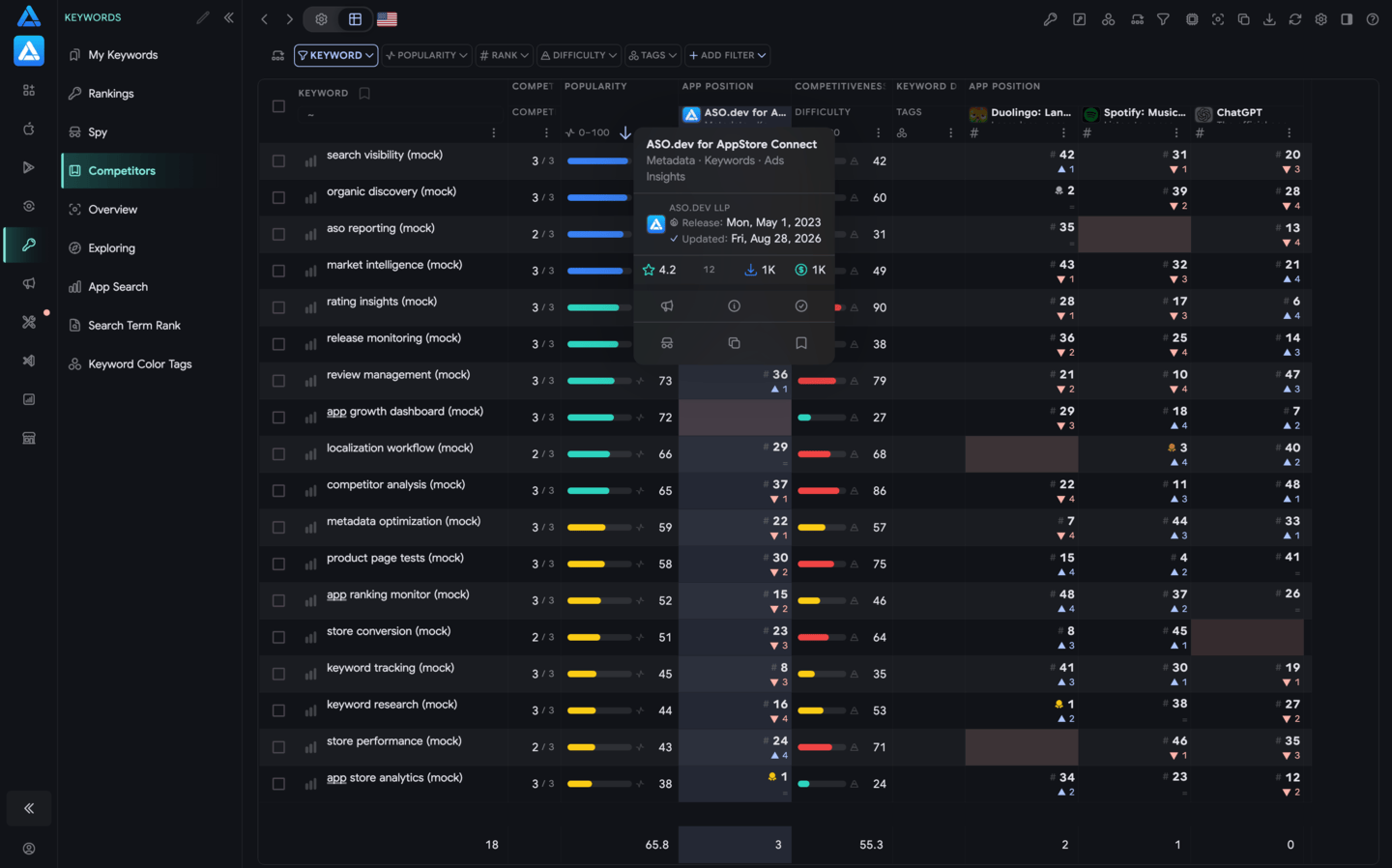
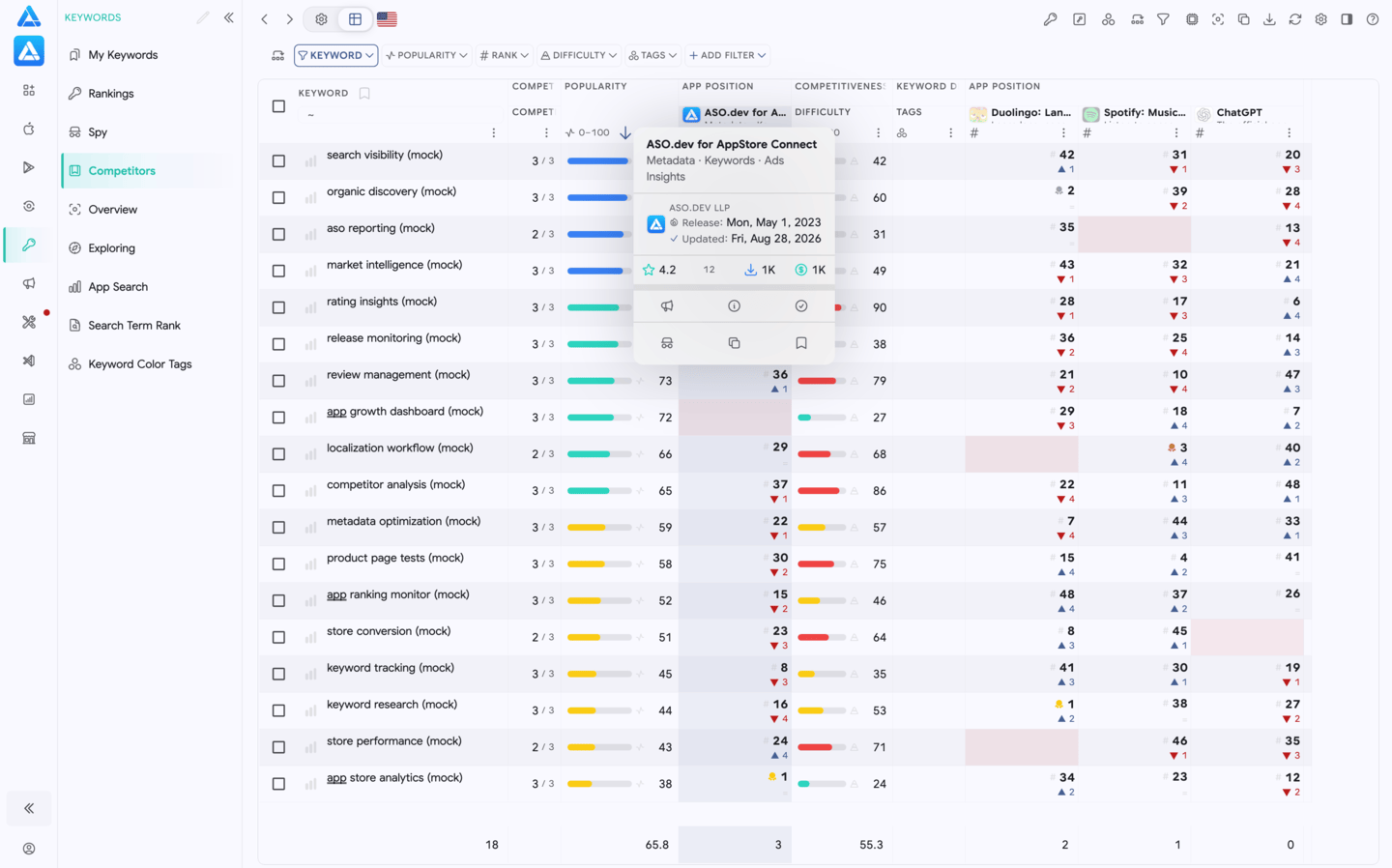
For multi-app comparison, we consider Keywords Competitors stronger than ASOmobile’s publicly documented Spy Keywords. It builds the union of selected competitors’ keywords for a country, date, and ranking ceiling (Top N), overlays your app and every competitor across two dates, and adds SAP, difficulty, suggestions, and advertising signals.
The entire discovered dataset opens in one desktop table, without collecting pages manually. The server returns one complete result; the interface renders only the visible area for speed. Filters, sorting, and Excel/CSV operate on the whole dataset. ASOmobile confirms multi-competitor comparison, gap discovery, and XLS on Max, but does not publish the maximum app count, set logic, or row and file limits.
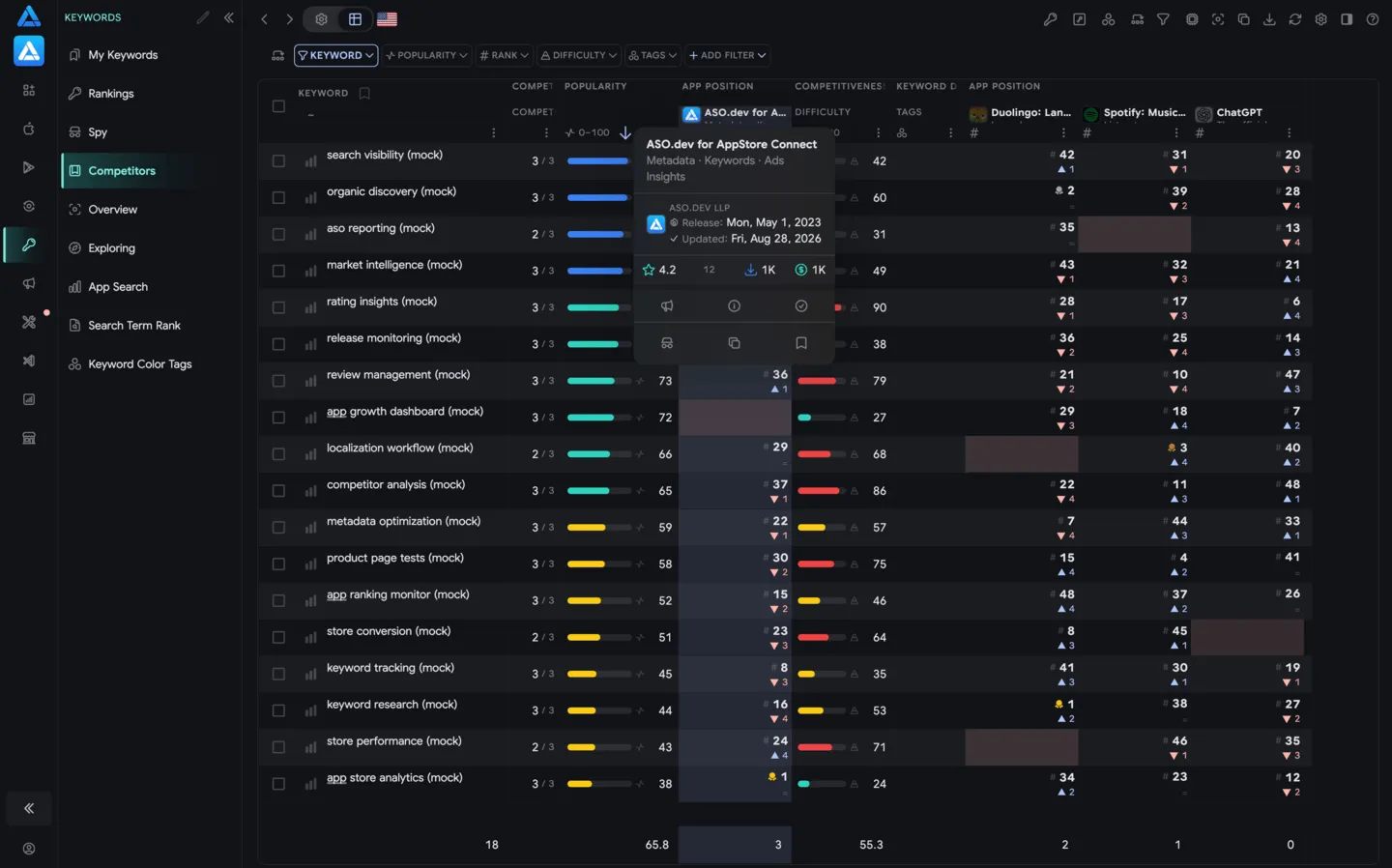
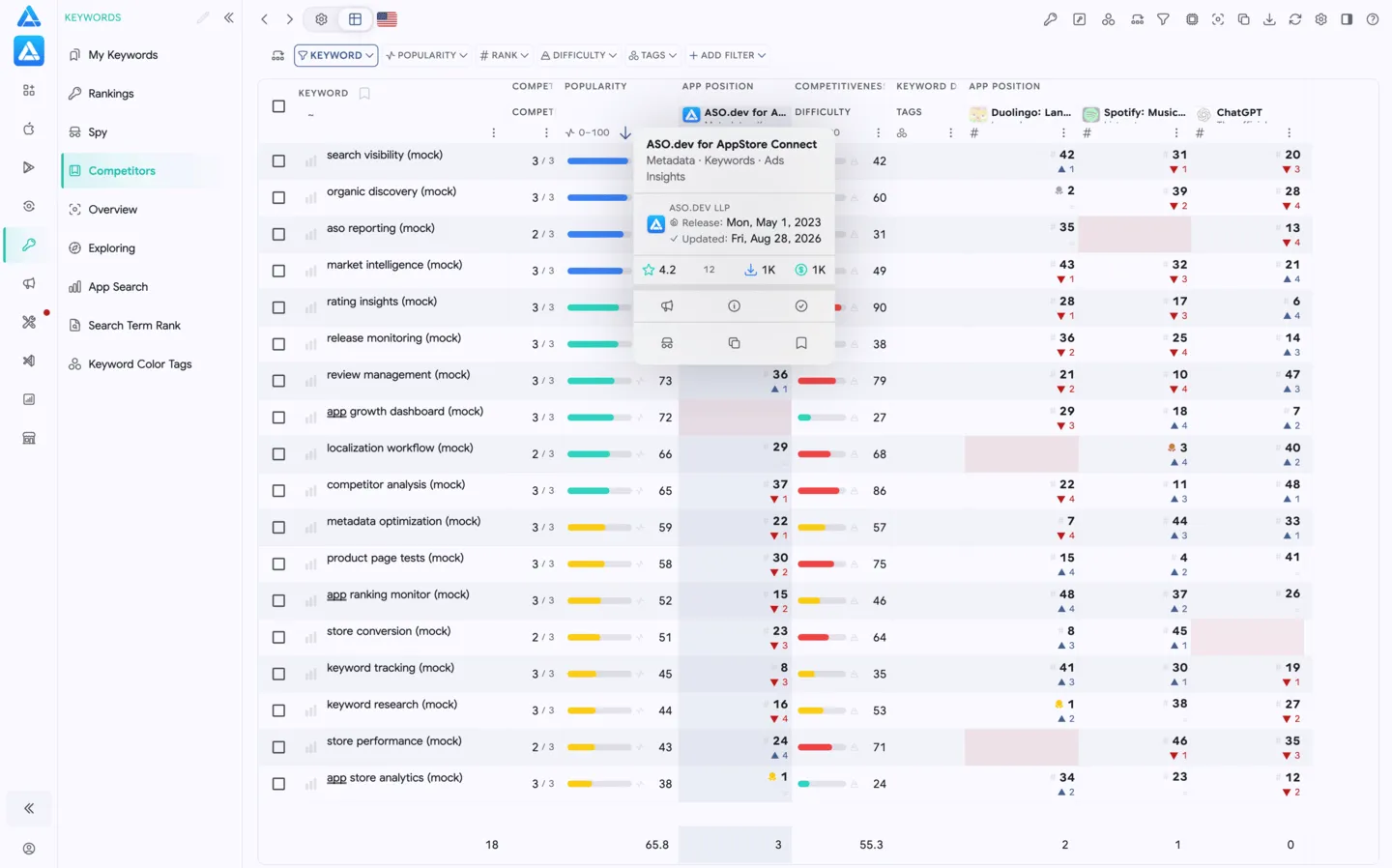
One table shows which keywords rank for the selected apps and where gaps remain. You can filter and export that same dataset without collecting results page by page.
Keyword List checks rankings every four hours and keeps history with the check timestamp. Competitor rankings use a daily snapshot; SAP refreshes separately each day. ASOmobile says Keyword Monitor updates roughly every six hours in the App Store and twelve hours in Google Play, plus manual refresh. Other pages say four hours or daily tracking, while App Keywords says 48 hours. There is no single public refresh rate for all data.
Top Charts, category history, Similar Apps, Timeline, and locale analysis are not unique to ASOmobile. In ASO.dev, Top shows free, paid, top-grossing, and new apps, while Category Ranking shows a snapshot and history.
App Info shows related apps and a reverse recommendation graph.
Changelog records versions, copy, icon, screenshots, and localizations for any App Store app.
App Overview collects localizations and store cards by country, while App Clash compares multiple apps and visual elements. This covers the practical need for charts across keywords, categories, locales, and competitors, although the fields and interface are not one-to-one copies of ASOmobile.
A competing app’s Keywords field in App Store Connect is private, so an external service cannot read it directly. The practical substitute is to monitor public copy, organic rankings, and the query set in which an app starts or stops ranking; icons and screenshots can be compared directly.
ASOmobile Timeline separately lists price, category, and size. Its public description does not confirm a specific notification channel for competitor metadata changes. ASO.dev Changelog keeps history, but we also do not yet promise device notifications or webhooks for those changes.
ASOmobile’s real advantage at this stage is one web interface for two stores, Store Insights, featuring data, and modeled download and revenue estimates. The main market-intelligence modules are available on Maximum; proprietary estimates are not direct competitor reporting.
This uncertainty matters for any model that relies on SAP. From late September to early October 2025, Apple sharply changed Popularity: the number of US queries with SAP above 5 fell by 77.4%, and the API began returning 5 for many keywords. We documented this anomaly in detail.
ASO.dev shows SAP sourced from Apple, its history, and check time instead of turning an indirect signal into a pseudo-precise search count. After the anomaly, the displayed average explicitly excludes new distorted fives while raw values remain in history.
In our internal observations, we refreshed SAP more often and across a broader query pool than the comparable ASOmobile screen. There is no public independent comparison of frequency and coverage.
ASOmobile also responded to the anomaly: its 2025 update overview describes current and previous Search Ads Index values, plus SAP history in Keyword Monitor, App Keywords, Keyword Finder, and Spy Keywords. This helps reveal the signal shift but does not explain how Traffic was recalculated.
ASOmobile Search Ads Spy shows advertised apps by keyword, an app’s advertising keywords, SAP, countries, period, and impression share. We found no public confirmation of Google Ads data, Apple campaign management, Ads 1/Ads 2 classification, or discovery of actual custom product pages and advertising creatives.
Apple Ads shows both ad placements: Ads 1 and Ads 2.
Ads by Keyword shows advertisers, actual creatives, and custom product pages (CPP).
App Ads provides the reverse path from an app to advertising keywords and creatives. A selected asset can return up to 5,000 related queries. This is a result limit, not attribution and not 5,000 keywords for every screenshot.
An active Marketing subscription monitors SOV for 200 keyword-and-country combinations roughly every seven minutes.
A separate dynamic pool with average SAP (AvgPopularity) of at least 60 contained about 45,000 queries during the original August 2026 review; this is a snapshot, not a fixed quota. New results are published roughly every 20 minutes, but that does not mean a full pass through the pool every 20 minutes; SAP itself refreshes daily. The timestamp shows when we checked, not when Apple changed the data.
ASO.dev does not manage bids or advertising campaigns. We also did not confirm Google Ads integration or campaign management for ASOmobile. This comparison is about observing Search Results and competitors, not replacing an advertising console.
ASO Generator starts from an app description, discovers keywords, suggests competitors, and creates metadata for both stores. A person reviews the list and copy, then downloads the result or sends it to ASO Creator. This consumes the plan’s separate AI quota.
ASO Creator imports copy, checks length, coverage, and duplicates, creates a draft in a selected language, and exports a file. We found no public confirmation of direct metadata and screenshot submission, bulk media work, releases, built-in A/B tests, custom product pages, or product-page experiments. This is an evidence boundary, not a claim that a private feature definitely does not exist.
In ASO.dev, research continues into practical work. App Overview and App Clash help verify localizations and visual assets.
The Metadata Editor extends copy across 50 App Store localizations. The Figma workflow moves it through JSON/ZIP while preserving Auto Layout, Variables, and right-to-left layout (RTL), avoiding a manual rebuild for each language.
Screenshots and video are mapped across localizations and devices. Agent Skills, reusable instructions for AI, help turn media, feature, and review observations into a testable hypothesis list.
The same media workflow applies to the default product page, CPP, and product page optimization experiments (PPO); PPO supports up to three variants.
After checking the result, a person explicitly starts review submission and publishing.
Versions and releases are managed in App Store Connect or Google Play Console.
This is a global, controlled workflow rather than an autonomous autopilot. People review translations and visuals, while Xcode, Fastlane, or CI still uploads the iOS binary.
ASO.dev is not only a keyword tracker: the ASO section includes 19 specialized tools. Beyond this workflow, the product includes analytical screens and separate work areas for stores, advertising, reviews, and automation. The full map is below; it does not mean that every feature is included in one plan.
Total cost of ownership (TCO) depends not only on plan price but also on what is constrained. A first cycle with 10 apps can fit Indie; ongoing professional work calls for Pro. ASOmobile fits 10 apps starting with Pro, but fitting the app limit does not establish that the tracked-keyword quota will cover the workload.
Prices below are US dollars before tax, showing monthly payment and the full annual charge separately. API credits fund programmatic requests; the AI quota covers AI operations inside ASOmobile.
| Plan | Monthly / annual price and public quotas |
|---|---|
| Free | $0: 2 apps; 20 keywords; 1 user; 10 competitors; 100 replies; AI — 0; API — 0 |
| Indie | $59 / $564: 5 apps; 500 keywords; 1 user; 50 competitors; 500 replies; AI — 0; API — 1,000 |
| Pro | $119 / $1,140: 10 apps; 1,500 keywords; 3 users; 150 competitors; 1,000 replies; AI — 100; API — 5,000 |
| Max | $229 / $2,196: 50 apps; 4,000 keywords; 5 users; 300 competitors; 2,000 replies; AI — 300; API — 50,000 |
| Maximum | $299 / $2,868: 100 apps; 6,000 keywords; 5 users; 1,000 competitors; 3,000 replies; AI — 1,000; API — 100,000 |
If each app-and-keyword combination is counted separately, 50 keywords for 10 apps create 500 combinations; 200 create 2,000, above Pro’s quota. If five countries are counted separately too, the range grows to 2,500–10,000 combinations. This models workload, not a confirmed ASOmobile billing formula.
The tracked-keyword quota must not be treated as the size limit of every research report. App Keywords, multi-app comparisons, and export limits are discussed separately below.
Our Indie costs $39 monthly or $348 annually per seat, does not cap the portfolio at the tenth app, and suits an independent developer’s first cycle. But we do not present it as a professional Pro equivalent: ranking history is limited to 30 days, with no exports, CPP, App Clash, Changelog, or extended history. PPO is available.
For ongoing work with 10 apps, we budget ASO.dev Pro at $828 per year per person. It costs $89 monthly. Marketing with Apple Ads costs $199 monthly or $1,788 annually.
An ASO.dev team can organize payment in two ways. Each specialist can subscribe through their own account while the team collaborates through shared workspaces. Or one payer can add several seats to a single purchase during checkout.
In both cases, every active specialist keeps an individual account and seat. The payment setup changes; the core ASO capacity available to each seat does not.
| Plan or configuration | Price | Workload planning guide |
|---|---|---|
| ASO.dev Indie, 1 seat | $348/year | A first ASO cycle, not the professional baseline |
| ASO.dev Pro, 1 seat | $828/year | One specialist; apps, keyword lists, and manual competitors without per-object limits |
| ASOmobile Pro | $1,140/year | 1,500 shared keywords: primarily one specialist with limited monitoring |
| ASOmobile Max | $2,196/year | 4,000 shared keywords; five logins do not expand that capacity |
| ASOmobile Maximum | $2,868/year | 6,000 shared keywords: consider for 2–3 active specialists |
| ASO.dev Pro, 2 seats | $1,656/year | Two specialists; each gets apps, keyword lists, and manual competitors without per-object limits |
| ASO.dev Pro, 3 seats | $2,484/year | Three specialists, each with the same core ASO capacity |
Login count is not working capacity. Split Pro equally among three specialists and each has 500 tracked keywords; split Maximum among five and each has 1,200. That is a small allowance for independent portfolios spanning several apps and countries. An extra login helps a colleague view results, but does not add keywords for an active ASO specialist.
Pro for one specialist and Maximum for 2–3 are therefore our planning estimates for regular work, not official ASOmobile limits. Equally divided, Maximum gives 2,000–3,000 keywords per active specialist, but adequacy still depends on apps and geography. This illustrates bundle capacity, not a confirmed keyword accounting formula across countries and devices.
Additional ASO.dev seats do not divide a shared limit on apps, keyword lists, or manual competitors. Two Pro seats cost $1,656 annually, three cost $2,484, and five cost $4,140; compute and machine-access quotas remain. Compare these amounts with an ASOmobile bundle after checking the same working dataset, not just how many people can log in.
ASOmobile can be cost-effective when several colleagues work with one small, fixed dataset or primarily need two-store data and market estimates. That is the benefit of shared access to a bundle, not a basis for treating it as a replacement for three or five independent seats handling broad portfolios.
Four differences matter when feeding a custom report or AI workflow. The contracts follow the table.
| Job | ASOmobile | ASO.dev |
|---|---|---|
| Server integration | Published REST API; consumes plan quota | Developer API: Pro+ subscribers can apply for testing; usage costs are still being evaluated |
| An assistant using MCP | API documentation access publicly confirmed | Local context and actions with user approval |
| A dataset of 20,000+ rows | Not confirmed for App Keywords | Pro+ exports the complete discovered set, including more than 20,000 rows |
| No manual page collection | One method has no page parameters; response cap unknown | Keywords Competitors receives one complete result and works locally |
MCP is a protocol through which an AI assistant gets context and invokes supported actions. File exports, local MCP, and Developer API have different economics; they are not interchangeable.
ASOmobile REST API. A personal Bearer token starts an asynchronous request and retrieves JSON by result ID. App Keywords works with one app and one country; a separate method works with one app and a country list. The schema has no pagination parameters: no page number, cursor, or link to the next portion. This does not prove an unbounded result.
The maximum request and response size, call frequency and concurrency, polling cost, result lifetime, and per-method cost are not publicly described. Several responses can be combined in custom code, but throughput and total credit cost for dozens of apps and countries cannot be promised in advance.
The 2025 update overview says App Keywords indexing capacity increased to 3,500 queries. This is the latest explicit number we found, not a freshly verified limit for every API response.
Spy Keywords compares several competitors, finds gaps, and exports XLS, but a multi-app API method, exact set logic, row and file limits, and a 20,000+ row export are not documented. We did not confirm 20,000+ rows from a single-app analysis through either the interface or API; that is unknown, not prohibited.
An older official article mentions 13,000+, but does not explain whether this was a sum across countries or a different metric. The 13,000+ figure therefore does not prove a 20,000-row export for one app.
App Ranking History separately documents chart positions for the last 30 days. This is a limit of that method, not a confirmed history depth for all of ASOmobile.
ASOmobile’s public MCP. The published configuration starts Apidog MCP with a site identifier and no ASOmobile Bearer token. Its tools read the OpenAPI specification to assist with coding; they do not call the API with access to working data. A documentation MCP is therefore confirmed, while an MCP for direct data access is not publicly confirmed. Reading the specification should not consume API credits; working REST calls do, while ASOmobile’s AI quota and the external model cost are separate.
A separate marketing page describes an agent retrieving current data. However, we found no public remote MCP endpoint, data-tool catalog, or authorization contract, so we do not apply that promise to the published Apidog configuration.
ASO.dev. Organic Keywords Task is limited to 20,000 rows, while Keyword Overview can produce up to 50,000.
Keywords Competitors on Pro exports the discovered union in full, after filtering, or by selection. It can exceed 20,000 rows only when enough source data exists; this is not a promise of 20,000 useful keywords for every app.
To find intersections and gaps in Keywords Competitors, filter by each app’s ranking presence and export the result. This uses the combined table; it does not promise a separate set-operation API. App Clash compares apps visually and is not a substitute for keyword intersections.
Local MCP deliberately does not expose the entire database. A large dataset is exported to Excel/CSV without per-row Developer API credits and analyzed in an external model.
The shortlist returns to Keyword List. MCP context is limited to the selected workspace, a supported editor, and the current or loaded review list.
MCP listens only on a local address, requires X-Client-Secret, and requires approval plus confirmApply for writes. It does not consume Developer API credits, but the selected external model may cost money.
The practical workflow has three steps: export the full file, analyze it in Codex, ChatGPT, Claude, or another model, and return the shortlist to Keyword List. MCP supports actions in editors and reviews; it is not for streaming tens of thousands of rows to a model one by one.
ASO.dev Developer API is a separate channel. Pro+ subscribers can apply for alpha testing, request 10,000 test credits through the portal, and create a token. Available methods already cover apps and metadata, rankings and history, keyword popularity and demand, and category charts.
Contracts, limits, and usage costs are still being tested, and there is no public SLA. Alpha applies to the API, not the local MCP. The general documentation still says “closed alpha”: applications to join are accepted, but access still requires account review.
ASOmobile collects App Store and Google Play reviews and provides filters, translation, templates, tags, charts, reply history, and XLS. Users can reply after connecting a store account; the monthly limit depends on the plan.
The official App Store instructions ask users to create a separate Customer Support user and enter its email address, password, and 2FA code into ASOmobile; Google Play connects through OAuth. We found no public description of credential storage or encryption.
Review webhooks, Slack/Teams/Zendesk routing, auto-reply rules, and a fully automatic server mode are also unconfirmed. A template alone does not prove automatic submission.
Our New Reviews Subscription monitors an app, country, and event combination. The result remains in Notifications and reaches the device.
On Pro/Marketing, a webhook sends a summary and a link to the full CSV. Active-rule limits are 2,500 / 6,500 / 13,000 on Indie / Pro / Marketing; treat the public CSV URL as a temporary secret.
A separate Reviews Export Task collects selected App Store countries for sentiment, theme, recurring-problem, and feature-request analysis. It turns a review stream into hypotheses but does not send replies without a user decision.
The Reviews interface creates and edits App Store and Google Play replies. Bulk AI replies use the instruction, provider, and model selected by the user; a person starts processing for the selected group.
MCP can draft, submit or edit a reply after confirmation, and report an App Store review. We do not promise a persistent event-driven server autopilot.
By default, the App Store Connect key and Google service account stay on the device.
Protected storage restricts local access, and requests go directly to Apple/Google or through the user’s proxy. Optional encrypted synchronization is convenient for a team but expands the security boundary.
When using external AI, the chosen model provider processes the text sent to it. Keeping a key local does not mean that all AI analysis stays on the device.
Google Play reviews expose only a recently modified feed of roughly seven days, not a complete historical archive.
In this setup, ASO.dev is the central workspace rather than a universal integration system. We do not promise automatic two-way synchronization of ASOmobile’s proprietary metrics: validated hypotheses and lists move between services, not the other provider’s full dataset.
ASO.dev vs ASOmobile: which should I choose for 10 apps?
For one specialist with an App Store portfolio, ASO.dev Pro costs $828 per year. If you need Google Play keywords and two-store data, start with ASOmobile Pro at $1,140 and check whether its shared keyword quota is sufficient. Three included logins do not by themselves make it a plan for three active specialists.
Is ASOmobile a competitor, equivalent, or alternative to ASO.dev?
It competes in keywords, monitoring, reviews, and part of Apple Ads, but it is not a complete equivalent. ASOmobile is stronger in Google Play and modeled estimates for two stores; ASO.dev is stronger in deep App Store work and direct execution.
Which ASOmobile alternative is suitable for publishing?
If the reason for switching is metadata, bulk screenshots, CPP/PPO, App Store Connect, Google Play Console, and releases in one workflow, that is a core ASO.dev area. If Android keywords and modeled market estimates matter more, we do not call ourselves a full replacement; ASOmobile can remain a second source.
Can I replace ASOmobile and keep the history?
Export keywords, competitors, and reports together with country, store, device, and timestamp definitions, then run parallel tracking in ASO.dev. Proprietary Traffic, CI/KEI, and modeled estimates cannot be guaranteed to transfer one to one.
Can I use both without duplicating work?
Yes, if roles are defined: ASOmobile supplies a necessary Google Play or market signal, while ASO.dev holds the working set and carries changes through publishing. There is no full synchronization, so do not pay for duplicate monitoring without a practical reason.
Can ASOmobile export 20,000+ keywords?
That volume is not publicly confirmed for ASOmobile. ASO.dev Pro+ can export the full discovered dataset, but its size depends on the source data. The report-specific differences are covered above.
Does MCP consume API credits?
ASOmobile’s documentation MCP should not consume them; working REST calls do. The local ASO.dev MCP does not deduct Developer API credits, while the external model is billed separately.
Does ASO.dev reply to reviews automatically?
It processes a group selected by a person and submits confirmed replies from the interface or MCP. We do not promise a persistent server autopilot.
Do I need a technical specialist?
Not for research, localization, publishing, or review handling. Custom server integrations need a developer; large exports and the local AI assistant can be used without writing code.
If a required feature is missing, suggest it or vote, or email hello@aso.dev.
Choose ASOmobile for Google Play keywords, modeled estimates for two stores, browser-based collaboration, and a published REST API. Choose ASO.dev when one specialist manages a broad App Store portfolio and must carry research through localization, creatives, reviews, and release. Use both when ASOmobile’s unique Google Play or market signal justifies the minimum bundle and the main work happens in ASO.dev.
Compare ASO.dev plansFor ASO.dev, we verified:
Unknowns remain:
Unknown does not mean absent.