You own 1–10 apps
You already know your market. You need to find keywords, update listings across countries, reply to reviews, and release updates without paying for every added research item.
We are the ASO.dev team. This comparison openly sets out both products’ strengths; facts were checked against official materials on August 2, 2026.
| Your task | A good fit |
|---|---|
| Evaluate a niche and estimated competitor revenue | FoxData. Modeled estimates and market breakdowns |
| Understand audiences, retention, and review themes | FoxData. Ready-made datasets and dashboards |
| Research a broad set of keywords and competitors | ASO.dev. Core research does not cost more for each added object |
| Roll out a hypothesis across 50 localizations | ASO.dev. Metadata, images, and store-console operations |
| Manage 10 apps as one specialist | Depends. Pro: $828/year for portfolio work; Standard: $602/year for 500 tracked keywords |
| Turn a market signal into changes across a portfolio | Both. FoxData for the decision, ASO.dev for validation and implementation |
You own 1–10 apps
You already know your market. You need to find keywords, update listings across countries, reply to reviews, and release updates without paying for every added research item.
You manage an ASO portfolio
You investigate broad keyword sets and many competitors. You need large working tables, history, exports, and a way to turn findings into store changes.
You work in product or growth
Before updating a listing, you need to understand the niche, estimated competitor revenue, audiences, and retention. This decision often starts with FoxData.
FoxData is not just another keyword tracker. It is a modular platform with ASO Intelligence, Ad Intelligence, and a separate application programming interface, or API. It helps you decide where to look: which niche is growing, what a competitor might earn, who its audience is, and which themes recur in reviews.
In ASO.dev, we build a workspace for the next question: what should change, and how do you get it into the store? After choosing a hypothesis, a specialist researches keywords and competitors, updates listings through our App Store Connect and Google Play Console editors, handles reviews, and prepares the next release.
ASO.dev can be a FoxData alternative for keyword research and everyday ASO work. It is not a like-for-like replacement for the whole platform: the next section explains where FoxData goes deeper.
For one specialist managing 10 apps, we usually recommend ASO.dev Pro: $828 per year, equivalent to $69 per month with annual billing. The reason is the professional feature set, not an app-count limit.
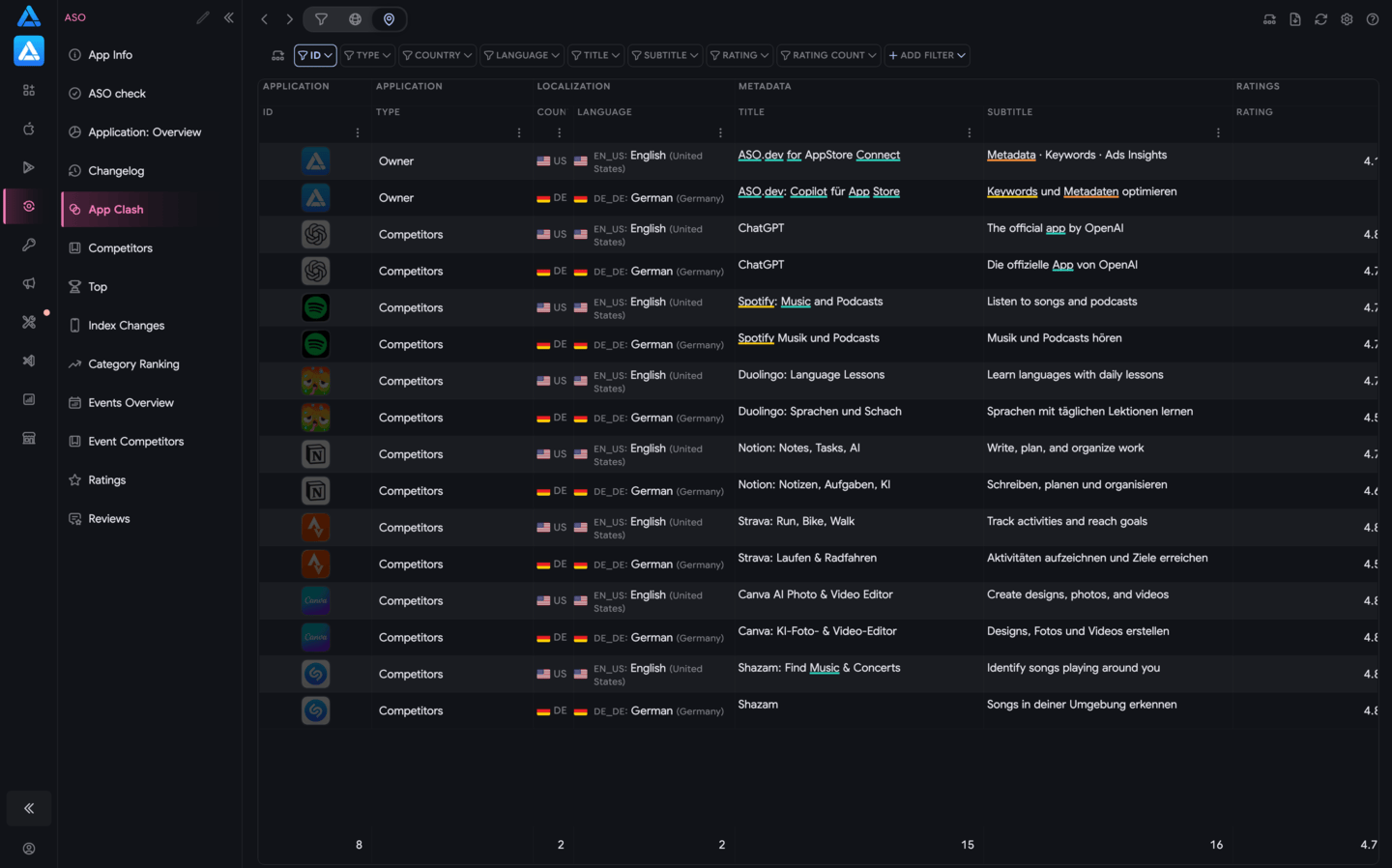
A portfolio needs exports, extended history, App Clash, Changelog, and custom product pages. These tools help compare options and evaluate the next release.
An owner working on their own apps may be comfortable with Startup at $348 per year if 30 days of history are enough and exports and professional page workflows are unnecessary. If Apple Ads is central to your work, choose Marketing: Pro does not include advertising intelligence.
Total cost of ownership, or TCO, depends on the apps, keywords, countries, modules, and seats the team needs. Below are the plans checked on August 2, 2026, followed by two workload calculations.
| Plan | Monthly | Annual | Capacity and history |
|---|---|---|---|
| Starter | $9.90 | $8.42/month equivalent | 1 seat; 3 apps; 90 keywords; 10 competitors; 3 months |
| Standard | $59 | $602 | 1 seat; 10 apps; 500 keywords; 50 competitors; 6 months |
| Growth | $159 | $1,622 | 3 seats; 20 apps; 1,500 keywords; 200 competitors; 12 months |
| Enterprise | Custom | Custom | Custom limits and all-time history |
Starter offers a seven-day trial. Standard adds dashboards, exports, alerts, and review analytics; Growth adds download and revenue estimates, market intelligence, and 15 AI review summaries per month. Confirm Enterprise’s scope if you need advanced IQ, audiences, or retention: its exact limits remain unknown.
Prices are per team member. Apps, core keyword lists, and manually researched competitors are not separate billable objects.
| Plan | Monthly | Annual | Intended work |
|---|---|---|---|
| Startup | $39 | $348 — $29/month equivalent | Your own apps, 30 days of history; no exports or custom product pages |
| Pro | $89 | $828 — $69/month equivalent | Extended history, exports, comparisons, and custom product pages |
| Marketing | $199 | $1,788 — $149/month equivalent | Everything in Pro plus Apple Ads Insights |
Startup excludes some professional workflows. Pro is the baseline for our scenario involving localizations, images, and experiments; additional specialists need additional seats.
| Workload, one specialist | FoxData | ASO.dev |
|---|---|---|
| Light: 10 × 50 = 500 pairs | Standard nominally fits 10 apps, 500 keywords, and 50 competitors: $59/month or $602/year | Pro: $89/month or $828/year for the full workflow; Startup at $348/year is the lower bound |
| Full: 10 × 200 = 2,000 pairs | Growth at $159/month or $1,622/year is capped at 1,500 keywords; choose Enterprise or cut at least 500 pairs | Pro: $828/year for one seat; apps, core keyword lists, and manual competitors do not increase the price |
We do not want specialists to decide, before researching, whether the 501st keyword or 11th app deserves a plan slot. ASO.dev’s main subscription unit is the person, not a row of data. You can narrow a broad sample after analysis rather than before it.
This does not mean there are no limits anywhere. We have removed as many restrictions as possible where they obstruct research, while keeping transparent operational quotas for frequency, computation, and plan-specific features.
Those quotas apply to individual Tasks, Subscriptions, advertising visibility monitoring, API calls, and some automated reports. They do not turn core ASO research back into a charge for each app, keyword, or manually added competitor.
Consider a modeled workflow for 10 apps, one specialist, up to five storefronts per app, and five competitors. The team updates metadata and releases monthly, then reviews the connection between feedback, features, images, and experiments quarterly. This is a sequence of decisions, not a fictional customer case or a calendar plan.
Find a market opportunity
In FoxData, the team compares category trends, modeled downloads and revenue, app, game, and regional research, audiences, and retention. Keyword Explore adds Search Volume, Opportunity, Difficulty, Correlation, and Install Estimate, plus category and long-tail discovery, AI recommendations, and Keyword DNA.
Live Search shows current App Store or Google Play results, while keyword history helps reveal changing demand. A person still checks the underlying evidence and product relevance: a proprietary metric or a release coinciding with growth does not prove causation.
Expand keywords and compare competitors
In ASO.dev, the specialist uses Keyword Explorer and Competitor Keywords, then examines apps, results, and change history from different angles.
One-click Tasks remove the manual search for an initial competitor set and organic keyword candidates. The competitor report returns up to 50 results on Startup and 250 on Pro/Marketing; the organic keyword discovery Task returns up to 20,000 results.
In the main app and keyword tables, the full returned result becomes one working dataset. You can filter, sort, select, and export locally instead of manually navigating dozens of 50–100-row pages. The desktop client is available for macOS, Windows, and Linux.
This does not mean pagination never exists: Reviews, TestFlight, and external Apple and Google APIs can load additional pages.
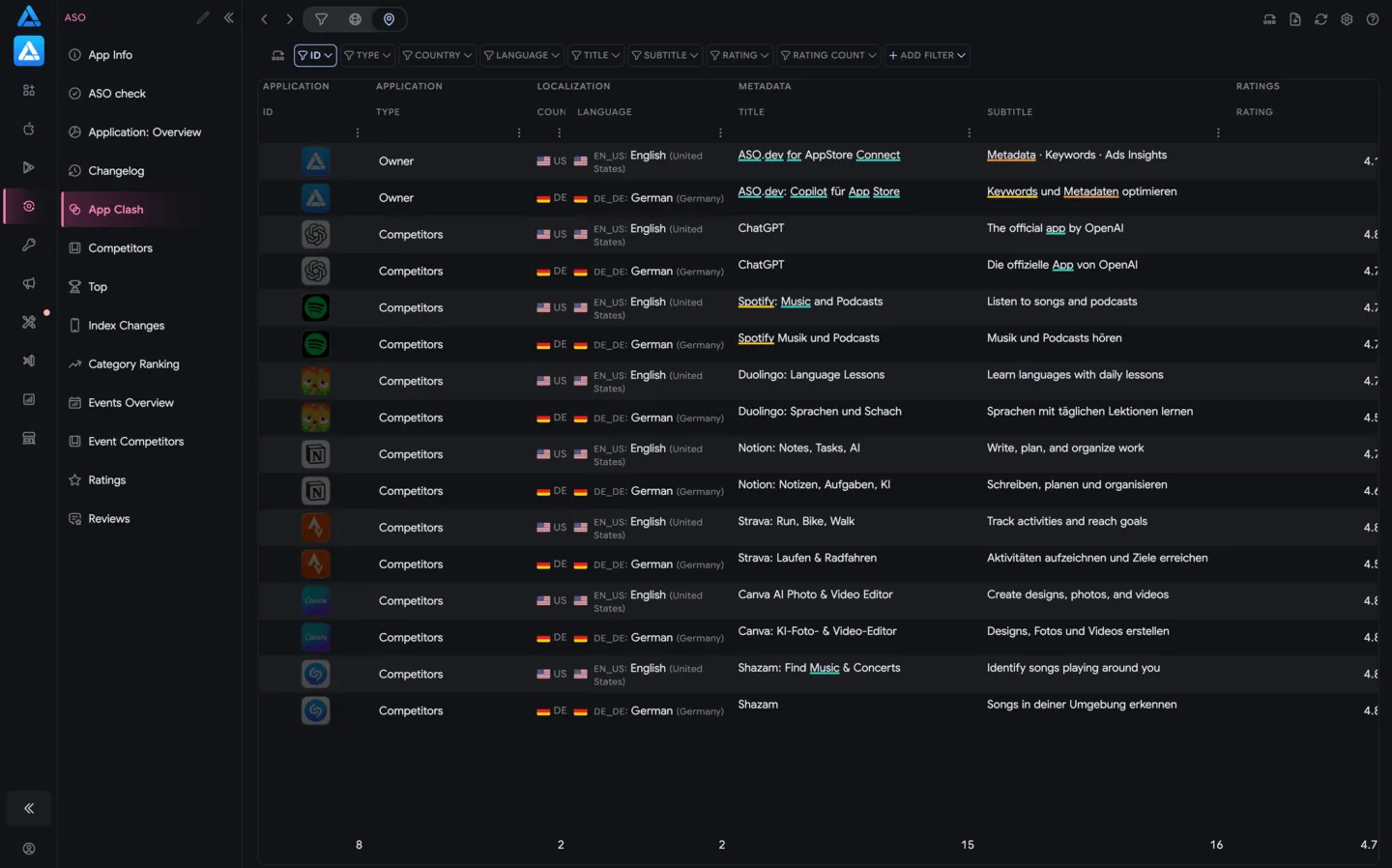
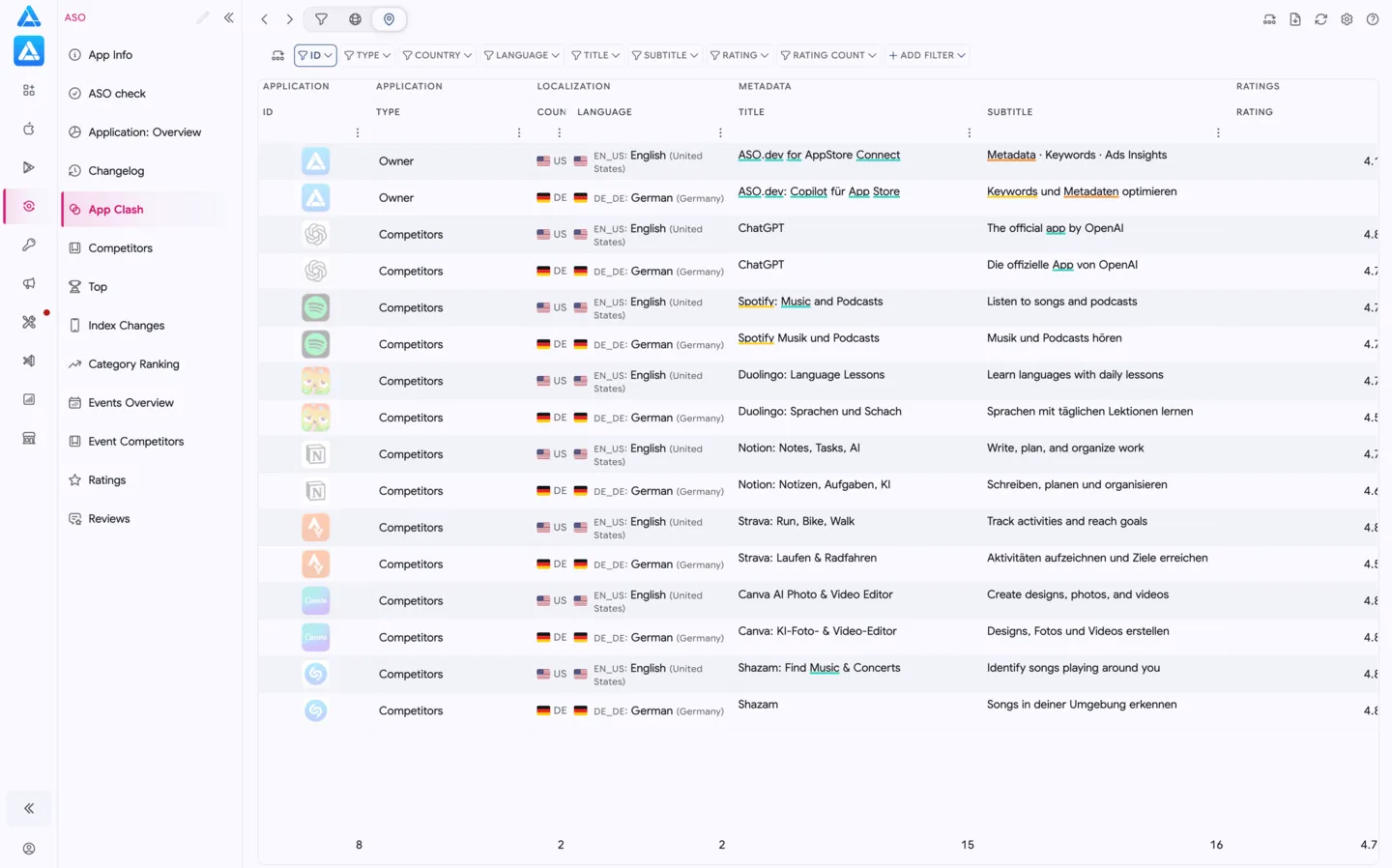
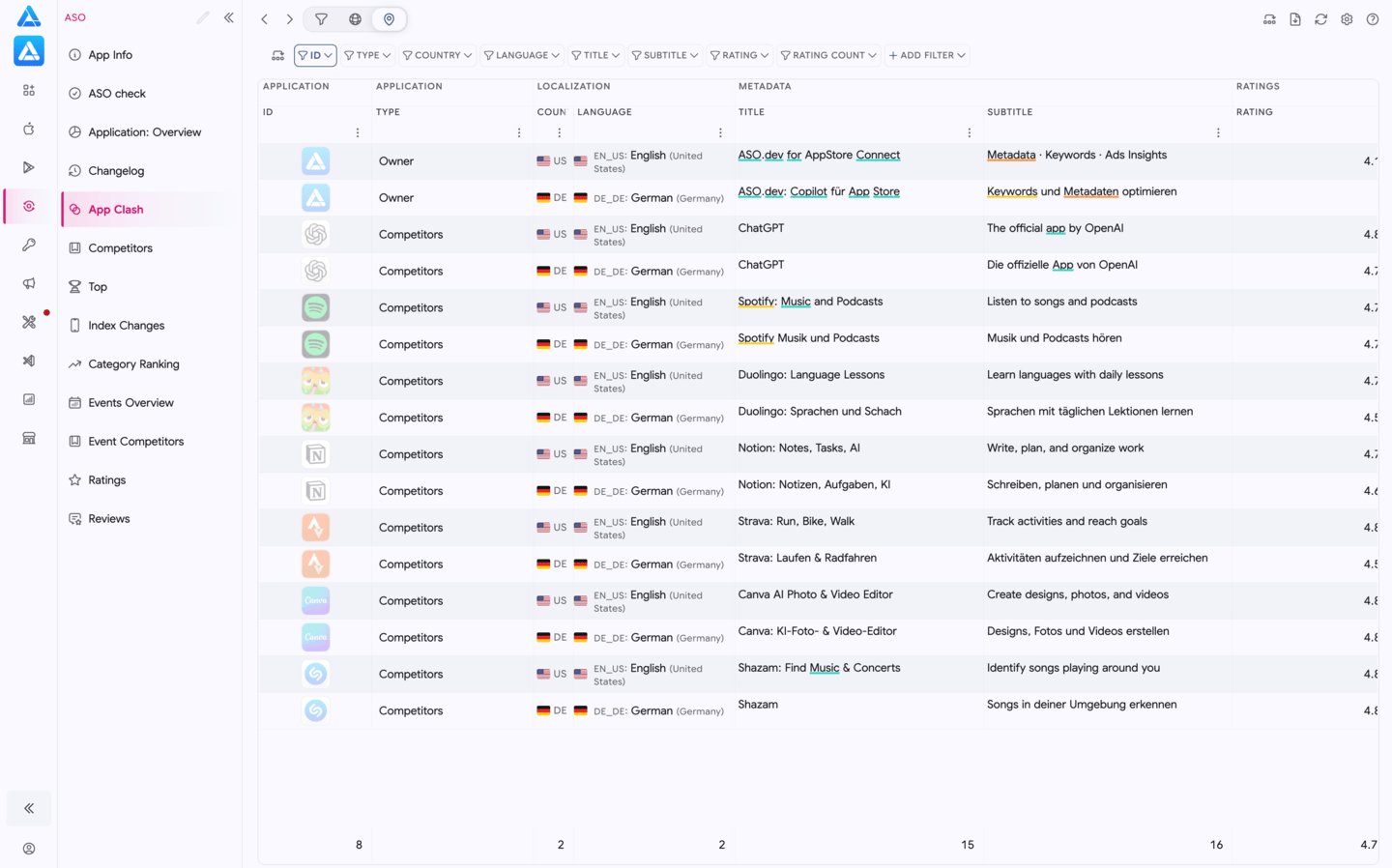
What you get: competitor titles and subtitles across localizations in one view, so you can compare how apps communicate their value in different languages.
Validate review themes and a product change
FoxData builds an overview through ready-made sentiment, topic analytics, and AI summaries. In ASO.dev, the team can export an app’s reviews by country, examine themes with an external AI model, then return to specific reviews and replies.
Subscriptions track new events, the interface helps prepare replies, and AI can fill a single draft or a batch. A person still validates the product hypothesis: ASO.dev does not claim to automatically mine feature requests across the entire review archive.
Roll out copy and images globally
Cross-localization and Bulk Editor translate, edit, and validate metadata for up to 50 supported App Store localizations. One idea becomes a working set for different markets instead of dozens of manually assembled listings.
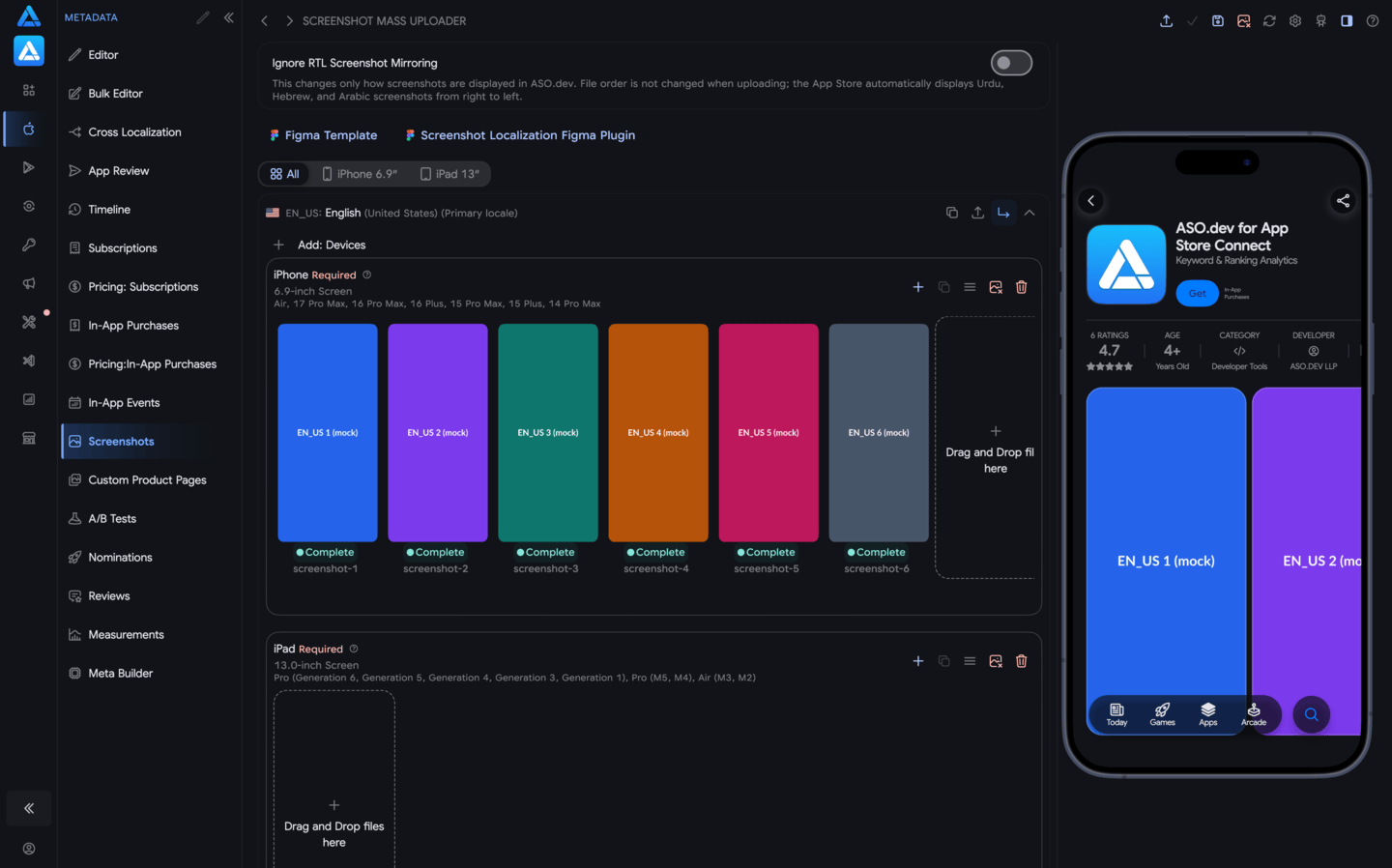
The production process has three connected parts:
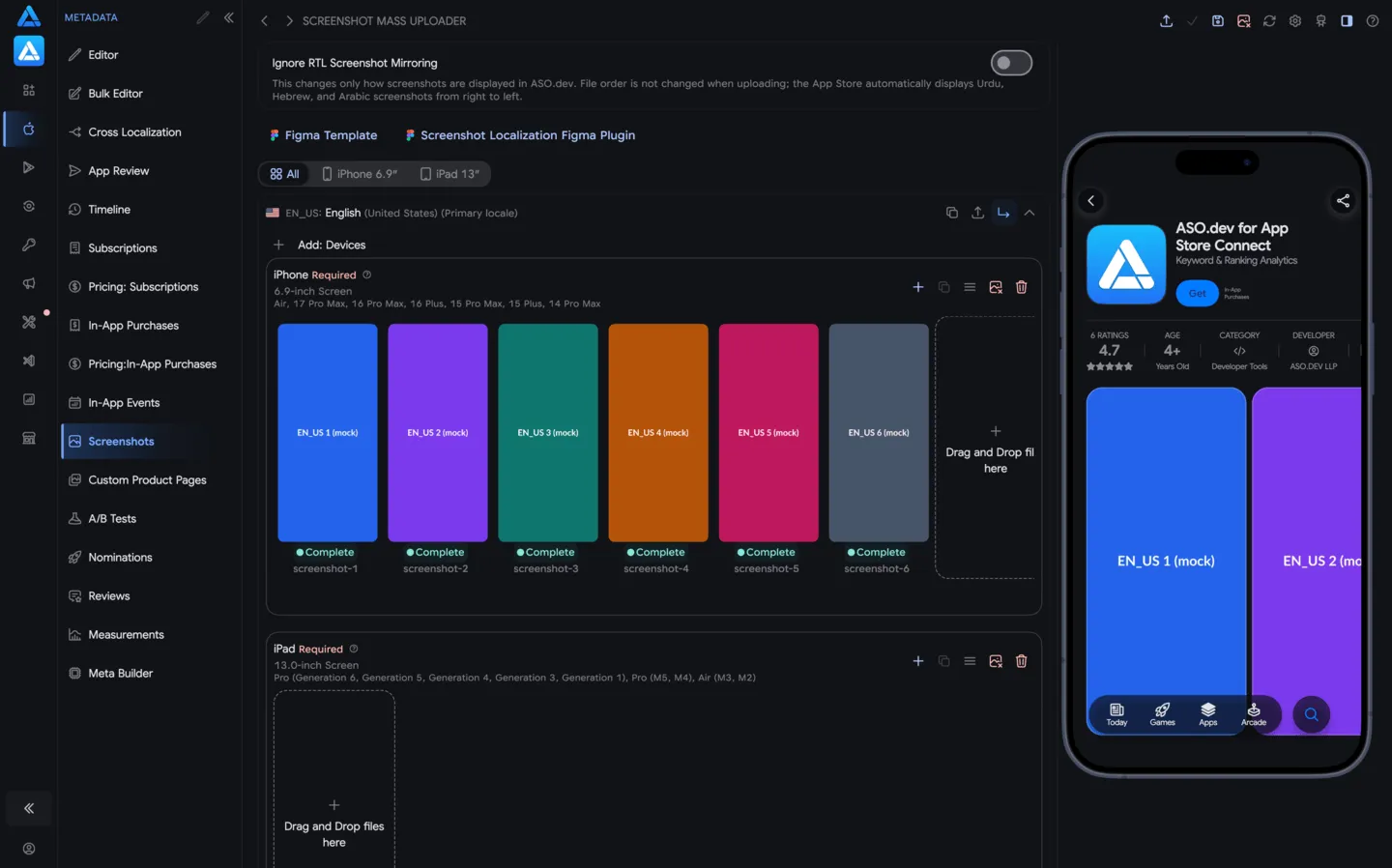
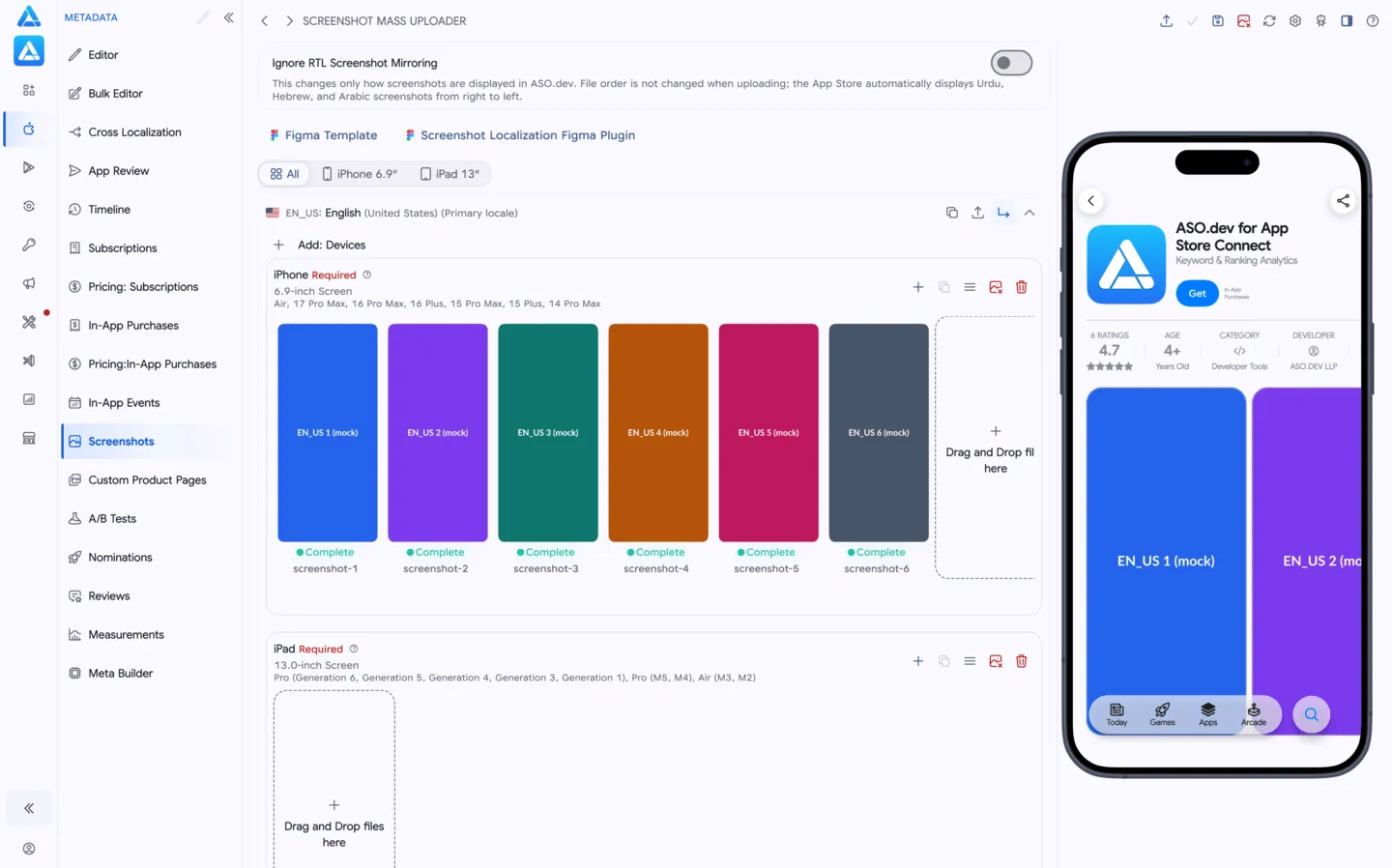
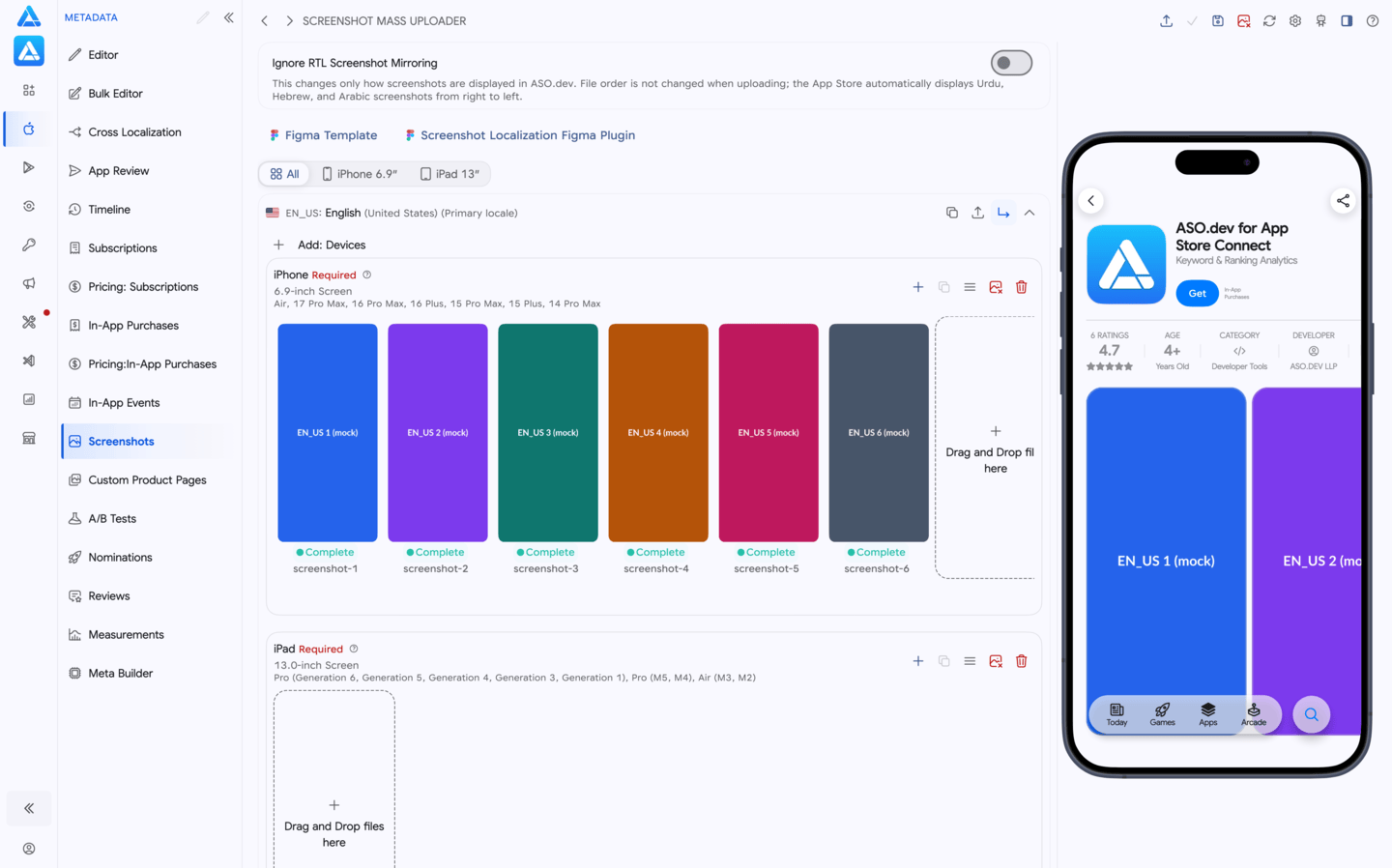
What your team gets: localized images organized by device and ready to check before submission to App Store Connect.
Publish and evaluate
The team explicitly saves changes and submits them for review. For custom product pages, you can copy localizations, images, and promotional text between pages and upload assets in bulk; Apple allows up to 70 pages. A product-page test supports up to three treatments with localized images or video.
Work continues beyond metadata:
After release, the specialist compares rankings, conversion, and their own revenue with the changes. Neither product removes the need for human review of the product, translations, or causes of the result. PPO works with an approved app version, and icon variants must already be included in the binary.
FoxData confirms console connections for actual downloads and revenue from your own apps and for review replies. This is useful, but we did not find an end-to-end path in its official documentation from bulk metadata localization, custom pages, and page tests through release and TestFlight. Metadata Simulator creates and evaluates a proposal; we also could not confirm direct metadata publishing through it.
For understanding what users say at scale, FoxData offers ready-made sentiment and topic dashboards, User Profile, AI summaries, and AI Quick Reply. ASO.dev has less preconfigured reputation analytics, but connects monitoring, exports, controlled AI replies, and actual submission to the store.
An ASO.dev Subscription watches an event for an app-country combination. The result stays in Notifications and can arrive by push notification or webhook on Pro/Marketing. The webhook includes counts, a preview, and a link to the full CSV.
The interface shows rating, country, reply status, whether the review changed after a reply, and translation. A separate Task exports any app’s reviews from selected countries—up to 175—to CSV for sentiment, topic, and feature-request analysis.
If you work with an AI assistant, it can help apply a reply as well as suggest its wording, after your confirmation. Our local AI Companion (MCP) connects your chosen AI to the current app screen. MCP stands for Model Context Protocol.
| Review task | FoxData | ASO.dev |
|---|---|---|
| Monitoring | Alerts; conditions depend on the plan | Subscriptions, push, webhook on Pro/Marketing |
| Analysis and export | Sentiment, topics, profiles, AI summaries | Filters, translation, CSV, and external AI |
| Direct replies | App Store and Google Play after connection | App Store and Google Play through UI and MCP |
| AI draft | AI Quick Reply and templates | Your prompt and chosen AI provider |
| Batch replies | Detailed rules and limits unconfirmed | User-triggered by date range, status, and rating |
| Autonomous event reply | Not confirmed by official materials | No server-side autopilot |
| AI access to current context | Official MCP unconfirmed | Local MCP; writes require confirmation |
| Store credentials | Key/JSON upload; storage not described | On-device; requests go directly to the store |
Single replies and batches use your own key for your chosen AI provider (BYOK): ASO.dev does not sell separate credits for each reply. A batch generates and submits replies sequentially only after the user starts it. This is user-triggered batch automation, not an always-on bot.
Our local MCP reads the current review or loaded list, filters it, and loads subsequent source pages. It can fill, submit, or edit replies in the App Store and Google Play; reporting a review is supported only for the App Store. Bulk fill prepares drafts, while submitting a specific reply is a separate supported action. Every write requires explicit confirmApply=true after user approval.
For the App Store, an individual key needs the Customer Support role; a team key needs Admin. A Google Play service account needs View app information (read-only) and Reply to reviews permissions.
MCP works with the active screen and loaded context, not the whole archive automatically. For the full dataset, use CSV or Excel, analyze it with your chosen AI model, validate themes yourself, then use MCP for actions on current reviews.
After spotting a competitor’s ad, you can investigate its related queries and choose an idea for your own page. ASO.dev Marketing and FoxData Ad Intelligence answer some of the same competitive questions. In ASO.dev, you can go both ways: from a keyword to advertisers, creatives, and custom pages, or from an app to its advertising keywords and assets.
| Question | What ASO.dev shows | Important boundary |
|---|---|---|
| Who advertises for a query? | Ads 1 and Ads 2, advertiser, creative, or custom page | Ads 2 is the second ad slot and third overall position, not all Apple Ads placements |
| Where did an observed creative appear? | Up to 5,000 related queries for a selected creative or page | Placement context, not conversion attribution |
| How did ad visibility change? | History and last-check timestamp | Our check time is not the moment Apple changed its data |
| How often is a selected list checked? | About every seven minutes | One Marketing subscription: 200 keyword-country combinations |
| What is covered automatically? | About 45,000 queries with average Search Ads Popularity (SAP) 60+ | A separate process; no seven-minute promise for the whole pool |
According to ASO.dev data as of August 7, 2026, the system performs about 160 million search-query checks per day. This counts checks, not 160 million unique query texts. Live Search and user observations of advertising share of voice are excluded.
Ads by Keyword and Ads by App show related keywords, advertisers, creatives, and custom product pages.
Share of Voice (SOV) stores history for selected keyword-country combinations. Alongside SAP history and check timestamps, it helps distinguish changes in an app’s visibility from movement in the popularity metric itself.
FoxData Ad Intelligence cannot be called broader simply because it is a separate module. The products overlap in keywords, advertisers, creatives, and custom pages; we do not have a comparable official daily FoxData metric or an independent, shared coverage methodology. ASO.dev still does not replace FoxData’s broader market, audience, and retention intelligence.
You do not need a technical specialist for ordinary research. Export a large dataset to Excel, analyze it in Codex, ChatGPT, or Claude, review the conclusions, and apply them in the editor. A server API is needed when the process must run on a schedule or between systems.
| Question | FoxData | ASO.dev |
|---|---|---|
| Official MCP and status | Could not be confirmed on August 2, 2026 | Local alpha under testing: editor and reviews |
| What MCP does | Unknown; REST API is not MCP | Reads current context; supported actions require confirmation |
| Does MCP consume API credits? | Could not be confirmed | No; Developer API is separate |
| 20,000+ keywords for one app | Conditionally through REST API: up to 500 rows/page | Excel on Pro+; one-click Task separately capped at 20,000 |
| 20,000+ rows across apps | Raw intersection or gap export unconfirmed | App analysis and intersection exports on Pro+ |
| Export plan and format | API Solutions, JSON, up to 500 rows/page in 1011; UI file cap unknown | Pro+, Excel; limits depend on the report |
| Machine access | Separate REST API, prepaid credits | Closed Developer API alpha, credits, and pre-request estimate |
| Practical AI route | REST → JSON pages → external AI | Excel → external AI → local MCP |
FoxData offers a standalone REST API for iOS and Android data. Small costs $59 for 75,000 credits; Medium costs $199 for 350,000. Credits do not expire, and both packages provide up to 12 months of history. Enterprise offers custom terms and all-time history.
Requests use JSON and an x-openapi-key. Keyword methods 1011 and 1012 document a limit of five requests per second; responses report the credit cost. Paginated methods return continuation information, and 1011 supplies up to 500 rows per request.
Getting 20,000 rows for one app in one country is therefore conditional: the app must actually have a sufficient totalCount. Your client must fetch at least 40 pages, respect the limits, pay credits, and assemble the file. We could not confirm 20,000+ raw rows across multiple apps or a ready-made intersection and keyword-gap file from the UI in official materials.
Method 1012 expands a set from an app and a keyword, or from one to five competitors, but does not promise a ready-made intersection, union, or gap classification. The app-versus-five-competitors comparison method returns aggregates, not 20,000 raw rows. Tracked-keyword export from the UI is confirmed, but its format and row cap are not officially published.
The unconfirmed FoxData MCP status means its transport, authentication, tools, quotas, and relationship to API credits remain unknown. A REST API or a user-built agent wrapper does not establish the existence of an official MCP server.
Paginated-method documentation describes next.taskId, next.pageKey, totalCount, and totalPages. The next portion is requested through common/next-page; next: null marks the end of the dataset. Method 1011 supports page sizes of 100, 200, or 500 rows for one app in one region per request.
A response may contain requestCredits, baseCredits, extraCredits, and the total cost. Alongside the five-requests-per-second limit for 1011 and 1012, there are per-minute, daily, and per-key limits; universal values for every account are not publicly stated.
Our recommended route avoids an expensive API call per row: Excel export → cleanup, deduplication, clustering, and relevance analysis with external AI → human review → local MCP for metadata, localization, and confirmed actions. Your chosen AI model’s tokens or subscription are paid independently of FoxData or ASO.dev.
Local MCP runs on your device at http://localhost:42111. You can enable a local secret and connect an AI client through an HTTP bridge or standard-input/output configuration. This is separate from Developer API.
The current alpha confirms app data and metadata, category rankings and charts, reviews, live keyword search, current and historical rankings, popularity, tracking lists, and projects. Limits depend on the method: examples include up to 1,000 app-ranking rows, 10,000 reviews, and 500 chart-method results. Current keyword rankings have separate offset, limit, and pricing rules.
Alpha means we are testing methods, load, data quality, and billing mechanics—not that the product has little data. Contracts, formulas, quotas, and prices can change.
In our experience, a professional ASO team can use several sources when each supplies a distinct signal. A combined stack is justified only when FoxData’s estimates, audiences, or retention data actually change the decision.
We do not promise automatic two-way synchronization or import of FoxData’s proprietary metrics. ASO.dev is not a warehouse for FoxData’s entire data model; it is a workspace for selected hypotheses and follow-through. If market estimates and audience data are not needed, ASO.dev alone can be enough.
Will one subscription cover 10 apps? Yes, for one specialist. Pro is the baseline for a professional portfolio; separate automation quotas are explained in the pricing section.
What would I lose by switching from FoxData? Market estimates, audiences, retention, demographics, and ready-made review analytics do not have equivalent ASO.dev features. Keep FoxData for that part of the work if you need them.
Does FoxData show actual competitor downloads and revenue? No. These are modeled estimates: useful comparisons, not a competitor’s internal reports. After connecting your own console, FoxData can show actual metrics for your apps.
Can I use both services? Yes. Move selected keywords and competitors into ASO.dev for ongoing tracking and operations, and keep FoxData for priority research. We have not confirmed a universal automatic sync between them.
Do I need a technical specialist? No—the interface covers research, exports, localization, reviews, and publishing. A developer is needed if you build your own server-side API process.
Does MCP consume API credits? Our local MCP does not; external AI costs are separate. FoxData’s official MCP itself remains unconfirmed, as do its terms.
Can I export 20,000+ keywords for AI analysis? On Pro and above, if the report contains that many rows. FoxData has a conditional, documented route through API pages for one app; the limits are explained above.
Who should choose FoxData? Strategy, research, and growth teams that need market estimates, audiences, retention, ready-made review analytics, or an iOS and Android REST API. FoxData is particularly useful before choosing a niche and product hypothesis.
Who should choose ASO.dev? Specialists managing a broad portfolio who need to turn hypotheses into keywords, localizations, images, replies, and changes in App Store Connect or Google Play Console. For professional work with 10 apps, start with Pro; for Apple Ads, Marketing.
When should you use both? When FoxData provides a distinct market signal within a small scope and ASO.dev handles broad app and keyword sets, global listing preparation, feedback, and the next release. You do not need both if market and audience estimates do not affect your decisions.
If ASO.dev is missing a feature your workflow needs, suggest it and vote at feedback.aso.dev, or contact us at hello@aso.dev. A request does not guarantee a roadmap commitment or delivery date.
Official FoxData materials used for verification are listed without clickable links:
ASO.dev materials: pricing, ASO tools, Tasks, Subscriptions, Notifications, reviews, security, metadata, AI Companion, Apple Ads, and Developer API. Relevant documentation is linked where each feature is discussed.